Post by cebudentalimplants (@cebudentalimplants)
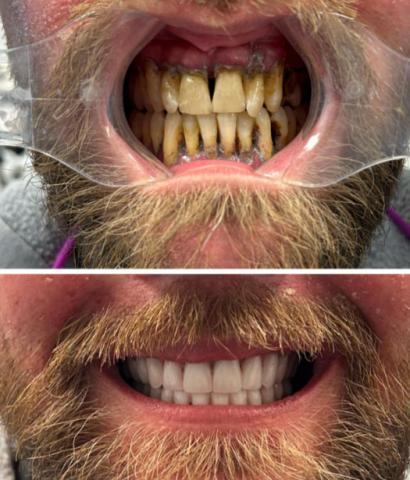
Image: Severity: ModerateTeeth Problems: Dental ImplantsGum infectionTeeth Case Analysis (Before & After)
Clinical Observation (Zoom-Level Review)
From the image provided:
Before Condition
Severe plaque and calculus buildup (heavy tartar deposits)
Advanced discoloration (brown/yellow staining)
Gingival inflammation (red, swollen gums)
Possible periodontal disease (bone loss likely)
Multiple cervical caries (dark lesions near gumline)
Tooth wear and uneven edges
Poor oral hygiene history
After Condition
Full-mouth rehabilitation completed
Teeth appear:
Uniform in shape and size
Significantly whiter (likely crowns/veneers or full prosthetic restoration)
Improved alignment and symmetry
Suggests:
Full arch crowns OR
Implant-supported prosthesis OR
Combination of extractions + prosthetics
Diagnosis (Deep Clinical Insight)
Primary Conditions
Advanced Periodontitis
Heavy Calculus Accumulation
Multiple Carious Lesions
Aesthetic Degradation
Possible Tooth Mobility / Bone Loss
Risk Level
High risk of tooth loss (pre-treatment)
Likely required full-mouth rehabilitation
Recommended Treatment Plan (Likely Performed)
Step-by-Step Process
Initial Assessment
X-rays / CBCT scan
Periodontal charting
Phase 1 – Infection Control
Deep scaling & root planing
Antibiotics (if needed)
Extraction of non-restorable teeth
Phase 2 – Surgical / Structural
Bone graft (if bone loss present)
Dental implants placement (if chosen)
Phase 3 – Temporary Restoration
Temporary dentures or provisional bridges
Phase 4 – Final Restoration
Zirconia crowns / full arch bridge
Implant-supported prosthesis
Can This Be Done in 14 Days?
YES — but only under specific protocol:
“Immediate Load / Teeth-in-a-Day” Approach
Typical 14-Day Timeline
Day 1–3: Extraction + Implant placement
Day 3–7: Temporary fixed teeth installed
Day 7–14: Healing + adjustments
Healing Time (Full Reality)
Stage
Duration
Soft tissue healing
7–14 days
Initial implant stability
2–6 weeks
Full osseointegration
3–6 months
Final prosthesis (permanent)
After healing
Risks if Rushed (14-Day Execution Issues)
If improperly planned, these may scale up:
Implant failure (poor bone integration)
Infection or swelling
Gum recession affecting aesthetics
Bite misalignment
Temporary teeth fracture
Need for re-treatment (cost increases)
Critical Factor: Bone quality & patient health
Professional Comment
This is a high-complexity full-mouth rehabilitation case.
The result shown is likely prosthetic-driven treatment, not just cleaning or whitening.
Strong indication of:
Full crowns OR
Implant-supported full arch restoration
Outcome quality: GOOD (aesthetic), but long-term success depends on maintenance.
FAQ – Full Mouth Dental Restoration & 14-Day Implant Treatment
Frequently Asked Questions
Can severe teeth conditions like this still be fixed?
Yes. Even with advanced damage (tartar, decay, gum disease), modern dentistry can restore function and aesthetics using full-mouth rehabilitation, implants, or crowns.
Is it really possible to complete treatment in 14 days?
Yes, using the immediate load / Teeth-in-a-Day protocol. However:
You will receive temporary fixed teeth first
Final permanent teeth are placed after 3–6 months healing
What happens during the first visit?
Full examination (X-ray or CBCT scan)
Treatment planning
Possible extractions and implant placement (same or next day)
Will all teeth be removed?
Not always.
Hopeless teeth (severe damage, bone loss) are extracted
Healthy teeth may still be preserved depending on condition
Is the procedure painful?
Done under local anesthesia or sedation
Minimal pain during procedure
Mild to moderate discomfort after (manageable with medication)
How long is recovery after implants?
Initial healing: 7–14 days
Functional recovery: 2–6 weeks
Full bone integration: 3–6 months
What are temporary teeth made of?
Usually acrylic or composite materials.
They are:
Functional
Aesthetic
Not as strong as final zirconia teeth
What are the final teeth made of?
Most clinics use:
Zirconia (highly durable and natural-looking)
Porcelain-fused-to-metal (PFM) in some cases
What risks should I be aware of?
If rushed or poorly planned:
Implant failure
Infection
Bite issues
Gum recession
Additional cost for corrections
Who is NOT a good candidate for 14-day implants?
Severe uncontrolled diabetes
Heavy smokers
Poor bone quality without grafting
Active infections not treated first
How long do dental implants last?
Implants: 10–25+ years (often lifetime)
Crowns/bridges: 10–15 years with proper care
How much can I save by doing this in the Philippines?
Patients from US/UK/Australia can save:
50% to 70% lower cost
Even with travel expenses included
Do I need to return after 14 days?
Yes, in most cases:
Follow-up visit after 3–6 months
Placement of final permanent teeth
(Some clinics offer remote coordination if return is difficult)
How do I maintain results after treatment?
Brush 2–3 times daily
Use water flosser
Regular dental cleaning every 6 months
Avoid smoking and excessive sugar
Recommendation (Action Step)
Visit a verified clinic near you:
https://cebudentalimplants.com/map-dental-clinic
Choose clinics offering:
CBCT scan
Implant specialists
Full-mouth rehab packages
Immediate load protocol
Before & After Case Studies
Severe Tartar Removal Case – Before & After
Full Mouth Restoration Case Study Philippines
Dental Implant Smile Makeover Results
Failed Dental Work Correction Case
Source: https://cebudentalimplants.com/full-mouth-dental-restoration-case-14-day-implant-guide
0 likes · 0 comments · 0 shares