Post by Oluwabukola Christiana (@bouqui)
👁️ PTERYGIUM: THAT FLESHY GROWTH IN THE EYE YOU SHOULD NEVER IGNORE!
What Everyone Should Know About Its Causes, Symptoms, Treatment and Prevention
Have you ever noticed a whitish or pinkish fleshy growth gradually spreading from the corner of someone's eye towards the black part?
Some people call it flesh growing in the eye. Others believe it is caused by excessive crying, smoke, spiritual attacks or simply getting older.
Because the growth may not initially cause pain, many people ignore it for years.
But what happens when that little growth begins to spread across the eye and interfere with vision?
This condition is called PTERYGIUM (pronounced tuh-RIJ-ee-um).
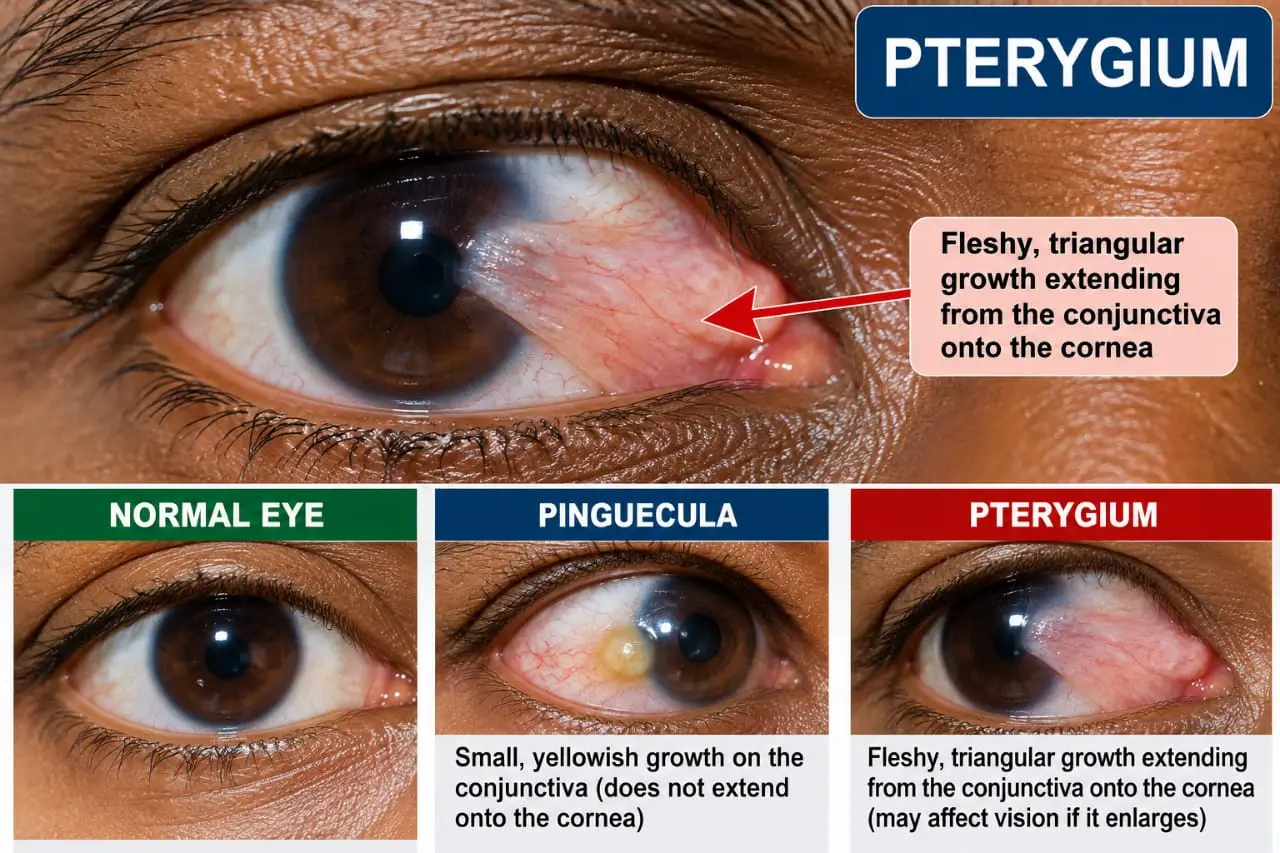
Pterygium is a non-cancerous, triangular or wing-shaped growth of tissue that develops from the conjunctiva, the thin membrane covering the white part of the eye, and extends onto the cornea.
The cornea is the transparent front surface of the eye that helps focus light for clear vision.
Pterygium commonly develops on the side of the eye closest to the nose, although it can also occur on the outer side. It may affect one eye or both eyes.
The major concern is that as the growth enlarges, it can distort the cornea and gradually interfere with vision.
One of the strongest risk factors for pterygium is prolonged exposure to ultraviolet (UV) radiation from sunlight.
This explains why the condition is relatively common in tropical countries like Nigeria, where people are frequently exposed to intense sunlight.
Farmers, commercial motorcyclists, fishermen, construction workers, roadside traders and other people who spend long hours outdoors may be particularly vulnerable.
Frequent exposure to dust, wind and dry environments can also contribute to irritation and increase the risk.
Pterygium is not contagious. It cannot spread from one person to another through physical contact.
In its early stages, pterygium may appear as a small, slightly raised growth on the white part of the eye.
Some people experience no symptoms, while others complain of redness, itching, burning sensations, excessive tearing, dryness or the feeling that sand is trapped inside the eye.
As the growth progresses, it may become more noticeable and cause blurred vision.
Interestingly, pterygium can affect vision even before it reaches the centre of the eye because it may change the shape of the cornea, resulting in astigmatism.
However, not every pterygium continues growing or causes significant visual problems.
Another eye condition commonly confused with pterygium is pinguecula.
A pinguecula appears as a small, yellowish or whitish raised area on the conjunctiva, usually near the cornea.
The difference is that a pinguecula remains on the conjunctiva, while a pterygium extends onto the cornea.
This distinction is important because both conditions may look similar initially.
One question people frequently ask is:
"Can eye drops remove pterygium?"
The answer is NO.
Lubricating eye drops, commonly called artificial tears, may relieve dryness, redness and irritation, but they cannot dissolve or remove an established pterygium.
When inflammation is significant, an eye specialist may prescribe additional medications.
However, people should avoid using steroid-containing eye drops without medical supervision because inappropriate use can cause complications, including glaucoma and cataracts.
When the growth becomes large, causes persistent irritation, significantly affects vision or threatens the visual axis, surgical removal may be recommended.
During surgery, the abnormal tissue is removed. A common technique involves covering the affected area with a small piece of healthy conjunctival tissue taken from another part of the same eye. This is called a conjunctival autograft.
The procedure is generally effective, but patients should understand that pterygium can grow back after surgery, although appropriate surgical techniques help reduce recurrence.
Not everyone with pterygium requires surgery. Some patients only need monitoring, symptom relief and protection from environmental risk factors.
Another important question is whether pterygium can cause blindness.
Most cases do not result in blindness. However, advanced growth can significantly reduce vision by distorting the cornea, causing scarring or extending across the visual axis.
This is why a progressively enlarging eye growth should never be ignored.
It is equally important to understand that not every fleshy growth on the eye is pterygium.
Some abnormal growths, including certain ocular surface tumours, may resemble it.
A lesion that grows rapidly, bleeds, changes colour or develops an unusual appearance should be assessed promptly by an ophthalmologist.
For nurses, early recognition and patient education are essential.
#Lekeelekee
#lekeelekeefamily
#viral
0 likes · 0 comments · 0 shares
Comments
Just finished following you.
If you love motivational quotes and inspiring words, check out my profile ❤️Follow for Daily motivation and positivity! 🙏