Post by GCE_A (@Mandingo_Hunter)
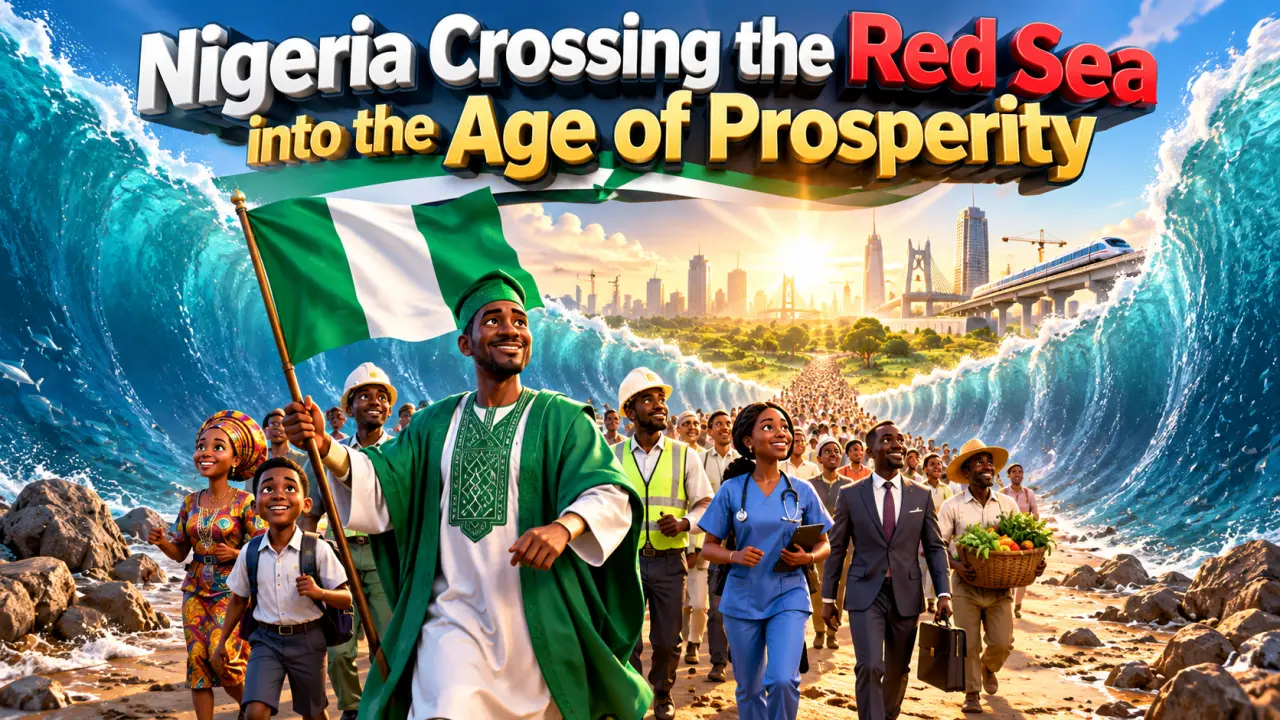
Nigeria Crossing the Red Sea into the Age of Prosperity
The waters may be parting. But crossing the sea is not the same thing as reaching the Promised Land.
There is something almost biblical about Nigeria’s economic journey of the past three years.
Behind us is an old economic order that had become increasingly difficult to sustain: expensive fuel subsidies, multiple exchange rates, chronic foreign-exchange shortages, deficit financing and a government revenue base too weak for the ambitions of a country of more than 200 million people.
Ahead lies the promise of something better: lower inflation, a more stable naira, stronger government revenues, growing foreign reserves, increasing investment and an economy capable of creating jobs and raising living standards.
And between the two?
The Red Sea.
For millions of Nigerians, that sea has been crossed barefoot.
Petrol became painfully expensive. Transport fares rose. Food prices climbed. Electricity tariffs increased for some consumers. Businesses struggled with financing costs. Salaries that once managed to stretch until the end of the month began surrendering somewhere around the second week.
That hardship cannot simply be edited out of the story because some macroeconomic indicators have improved.
But neither should the improvements be dismissed merely because Nigerians are still hurting.
Nigeria’s economic fundamentals are showing signs of repair. And the average Nigerian household has not yet received anything resembling an invitation to the prosperity party.
That distinction matters.
Look closely at the economy today and some important indicators have changed direction.
Nigeria’s economy expanded by 4.43 per cent year-on-year in the second quarter of 2026, up from 3.89 per cent in the first quarter. Oil production rose to about 1.72 million barrels per day during the quarter, while both oil and non-oil sectors contributed to growth.
Inflation, although still painful, has fallen substantially from the frightening levels Nigerians experienced earlier in the reform period. The National Bureau of Statistics currently reports headline inflation of 15.39 per cent, with food inflation at 19.57 per cent.
The foreign-exchange market has also become more orderly. On 2 October 2026, the official rate was around ₦1,329 to the dollar, a level that still represents a dramatically weaker naira than Nigerians knew a few years ago, but with considerably greater market stability than during the disorderly adjustment period.
Nigeria’s external buffers have strengthened too. The World Bank reported gross reserves of about $51.9 billion at the end of July 2026, compared with significantly lower levels earlier in the reform cycle.
Then, in September, the Central Bank made a significant move. After keeping monetary conditions exceptionally tight, the Monetary Policy Committee reduced its policy rate from 26.5 per cent to 23 per cent. That 350-basis-point reduction suggests that the authorities believe enough progress has been made on inflation and currency stability to begin cautiously easing the brake on the economy.
Even the IMF, hardly an institution given to emotional applause, concluded in June that Nigeria’s reforms had improved macroeconomic outcomes and strengthened resilience. It projected economic growth of about 4.1 per cent for 2026.
Something is moving.
The argument that absolutely nothing has improved is therefore difficult to sustain.
But so is the argument that Nigeria has arrived at prosperity.
This is where official celebration must exercise restraint.
A country does not eat GDP.
A mother standing before a pot of soup does not season it with foreign reserves. The mechanic in Kubwa cannot pay school fees with a stronger current-account balance. The pensioner buying hypertension medication is unlikely to be comforted by improvements in the yield curve.
Macroeconomic stability matters enormously because without it sustained prosperity is almost impossible.
But stability is the foundation of the house.
It is not the house.
The World Bank says household incomes have not fully recovered despite improving macroeconomic conditions. It estimates that 50.8 per cent of Nigerians, about 123 million people, lived in extreme poverty in 2025 under its stated poverty measure.
The IMF gives a similarly sobering picture. Using Nigeria’s national poverty line, it estimated poverty at 63 per cent, while about 27 million Nigerians faced food insecurity in late 2025.
There, in those figures, lies the distance between stabilisation and prosperity.
The patient may have stopped bleeding.
He has not yet started running.
Economic reform is usually politically easiest to defend when everything can still be blamed on inherited distortions.
That period eventually ends.
After stabilisation comes delivery.
If increased government revenue does not produce better roads, reliable electricity, functioning schools, stronger primary healthcare, improved security and productive infrastructure
0 likes · 0 comments · 0 shares