Post by Dr Esther Nsa Akachukwu (@dr_esther_nsa_akachukwu)
🌊🔬🎉 DAY 30 OF OUR 30-DAY PLANKTON JOURNEY! 🎉🔬🌊
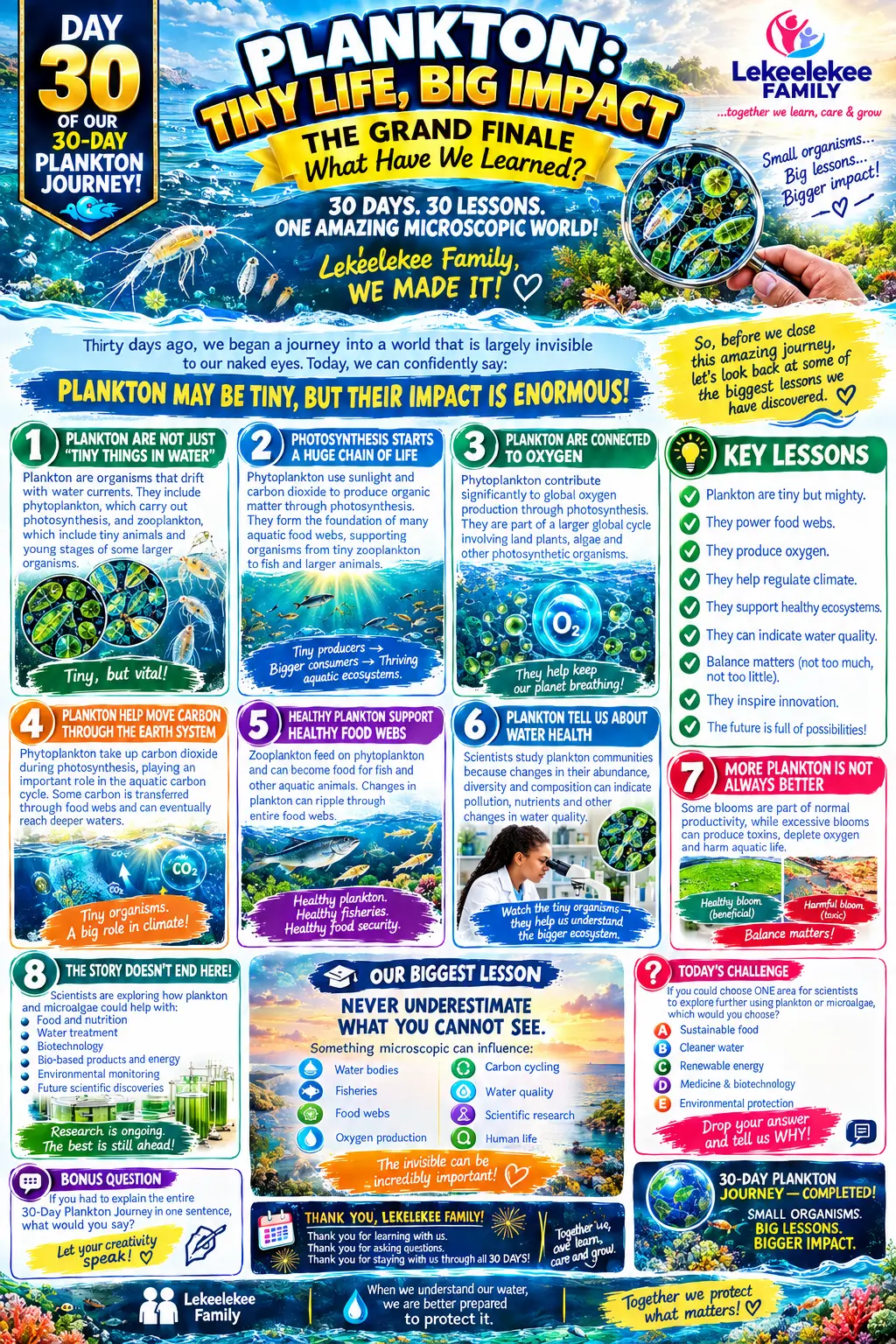
🌟 PLANKTON: TINY LIFE, BIG IMPACT
THE GRAND FINALE — WHAT HAVE WE LEARNED?
30 DAYS.
30 LESSONS.
ONE AMAZING MICROSCOPIC WORLD! 🌊💚
Lekeelekee Family, WE MADE IT! 🎉🎉🎉
Thirty days ago, we began a journey into a world that is largely invisible to our naked eyes.
Today, we can confidently say:
PLANKTON MAY BE TINY, BUT THEIR IMPACT IS ENORMOUS!
So, before we close this amazing journey, let's look back at some of the biggest lessons we have discovered. 👇
🌱 1. PLANKTON ARE NOT JUST “TINY THINGS IN WATER”
Plankton are organisms that drift with water currents. They include phytoplankton, which carry out photosynthesis, and zooplankton, which include tiny animals and young stages of some larger aquatic organisms.
☀️ 2. PHOTOSYNTHESIS STARTS A HUGE CHAIN OF LIFE
Phytoplankton use sunlight and carbon dioxide to produce organic matter through photosynthesis.
They form the foundation of many aquatic food webs, supporting organisms ranging from tiny zooplankton to fish and larger animals.
Tiny producers → tiny consumers → bigger consumers → thriving aquatic ecosystems. 🌊🐟
💨 3. PLANKTON ARE CONNECTED TO OXYGEN
Phytoplankton contribute significantly to global oxygen production through photosynthesis.
But remember our important lesson: the oxygen we breathe is part of a much larger global cycle involving land plants, algae and other photosynthetic organisms.
🌍 4. PLANKTON HELP MOVE CARBON THROUGH THE EARTH SYSTEM
Phytoplankton take up carbon dioxide during photosynthesis, making them important participants in the aquatic carbon cycle.
Some carbon is transferred through food webs and can eventually reach deeper waters, although the fate of that carbon is complex.
Something microscopic can therefore be connected to something as enormous as Earth's climate system. 🌍
🐟 5. HEALTHY PLANKTON HELP SUPPORT HEALTHY FOOD WEBS
Zooplankton feed on phytoplankton and can themselves become food for fish and other aquatic animals.
Changes in plankton abundance or community composition can therefore ripple through aquatic food webs.
💧 6. PLANKTON CAN TELL US ABOUT WATER HEALTH
Scientists study plankton communities because changes in their abundance, diversity and composition can provide clues about environmental conditions, including pollution, nutrients and other changes in water quality.
In other words:
WATCH THE TINY ORGANISMS — THEY CAN HELP US UNDERSTAND THE BIGGER ECOSYSTEM. 🔬💧
⚠️ 7. MORE PLANKTON IS NOT ALWAYS BETTER
We also learned that plankton blooms can have very different effects.
Some blooms are part of normal aquatic productivity, while certain excessive blooms can produce toxins or contribute to oxygen depletion and harm aquatic life.
Balance matters. 🌱⚖️
🚀 8. THE STORY DOESN'T END HERE!
Our Day 28 and Day 29 lessons showed us that scientists are continuing to investigate microalgae and other microscopic organisms for possibilities involving:
🌱 Food and nutrition
💧 Water treatment
🧬 Biotechnology
⚡ Bio-based products and energy
🌍 Environmental monitoring
🔬 Future scientific discoveries
The exciting part is that research is still ongoing. Some ideas are promising, while others still face important scientific, economic, safety and environmental challenges.
And that means there is still so much to discover!
💡 OUR BIGGEST LESSON
Perhaps the greatest lesson from this 30-day journey is this:
NEVER UNDERESTIMATE WHAT YOU CANNOT SEE.
Something microscopic can influence:
🌊 Water bodies
🐟 Fisheries
🌱 Food webs
💨 Oxygen production
🌍 Carbon cycling
💧 Water quality
🔬 Scientific research
👨👩👧👦 Human life
The invisible can be incredibly important.
🎯 GRAND FINALE CHALLENGE!
After 30 days of learning about plankton, tell us:
WHAT WAS YOUR MOST INTERESTING PLANKTON DISCOVERY? 🤔
Was it:
A. 🌱 Phytoplankton & oxygen
B. 🐟 Plankton & fish
C. 🌍 Plankton & climate
D. 💧 Plankton & water quality
E. 🧬 Plankton & biotechnology
F. 🔬 Something completely different!
👇 Drop your answer in the comments and tell us WHY!
💭 ONE LAST QUESTION
If you had to explain the entire 30-Day Plankton Journey in ONE SENTENCE, what would you say?
Let's see who can come up with the most creative answer! 😍👇
❤️ THANK YOU, LEKEELEKEE FAMILY!
Thank you for learning with us.
Thank you for asking questions.
Thank you for participating.
Thank you for staying with us through all 30 DAYS! 🎉🌊🔬
From the smallest microscopic organisms to the biggest environmental questions, we have discovered something truly remarkable:
**SMALL ORGANISMS.
BIG LESSONS.
BIGGER IMPACT.** 🌊💚
And as we close this chapter, let's remember:
WHEN WE UNDERSTAND OUR WATER, WE ARE BETTER PREPARED TO PROTECT IT. 💧🌍❤️
Lekeelekee Family — Together we learn,
#PlanktonJourney #Day30 #GrandFinale #LekeelekeeFamily #Plankton #Phytoplankton #Zooplankton #MarineBiology #AquaticEcosystems #EnvironmentalScience
#ScienceEducation #ProtectOurWaterBodies
0 likes · 0 comments · 0 shares