Post by Udeze Nestor (@Nesmoore1)
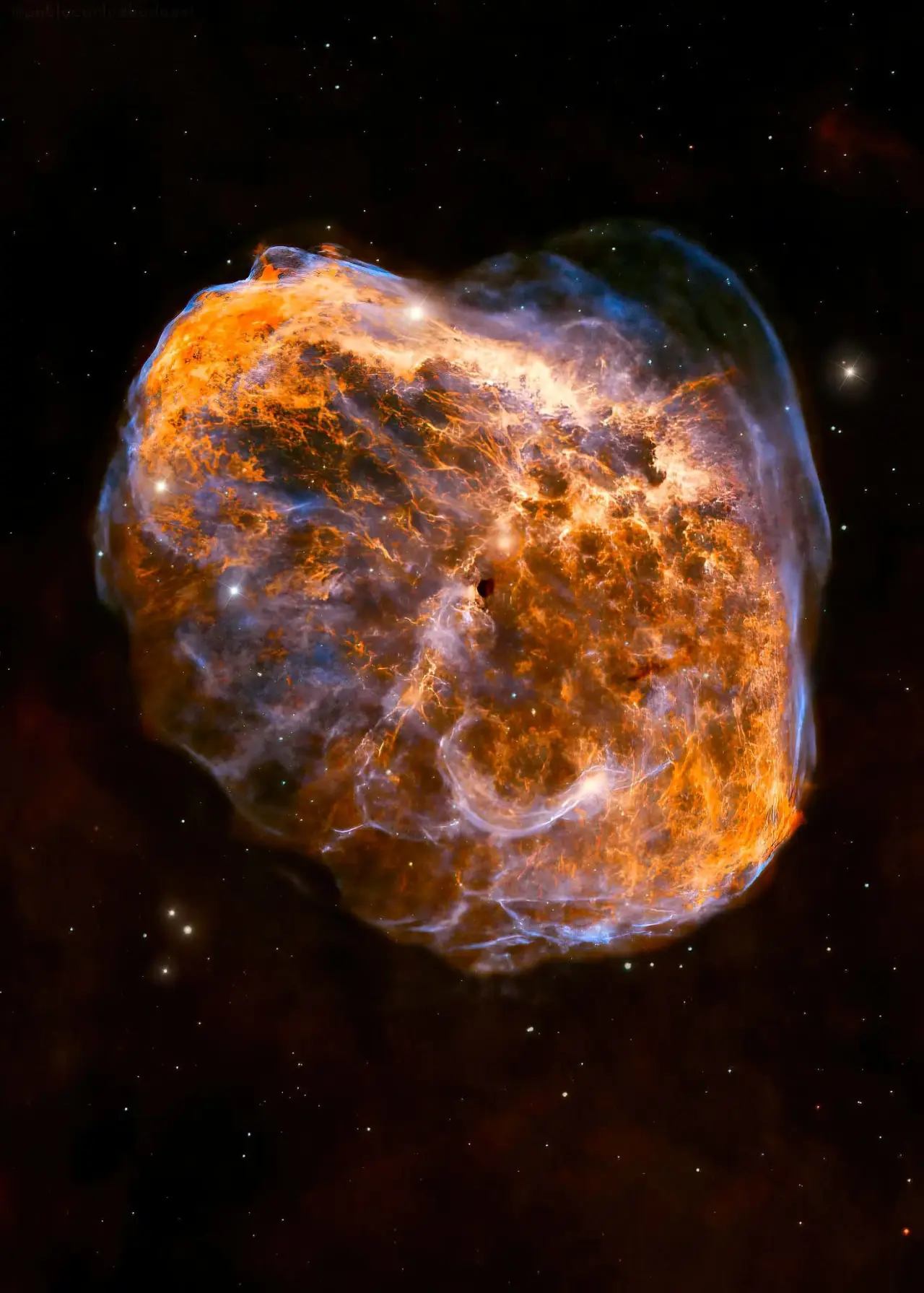
In the constellation Cygnus, about 5,000 light-years away, hangs a cosmic crescent — NGC 6888. It is not a quiet cloud, but a giant bubble some 25 light-years across, blown by the furious wind of a dying star.
At its heart burns WR 136, a rare and violent Wolf–Rayet star. Long ago it swelled into a red supergiant and shed its outer layers. Now a hurricane tears from its surface at thousands of kilometers per second. Every ten thousand years the star loses a mass comparable to that of the Sun.
This new, ultra-fast wind slams into the older, slower material — and the nebula’s intricate lacework is born: filaments, folds, shock waves. Inside the bubble the gas heats to millions of degrees and glows in X-rays; outside, the shell flares in hydrogen and oxygen, tracing the familiar crescent.
WR 136 lives too brightly and too fast. Nuclear fuel burns at a monstrous rate, and the star’s life is nearly spent. Ahead lies a supernova that will briefly outshine a galaxy and tear this crescent to shreds.
For now NGC 6888 hangs in the sky as the last breath of a colossal star — beautiful, fragile, and already doomed. 🪐
0 likes · 0 comments · 0 shares