Post by Dr Esther Nsa Akachukwu (@dr_esther_nsa_akachukwu)
🌊🔬 DAY 16 OF OUR 30-DAY PLANKTON JOURNEY! 🔬🌊
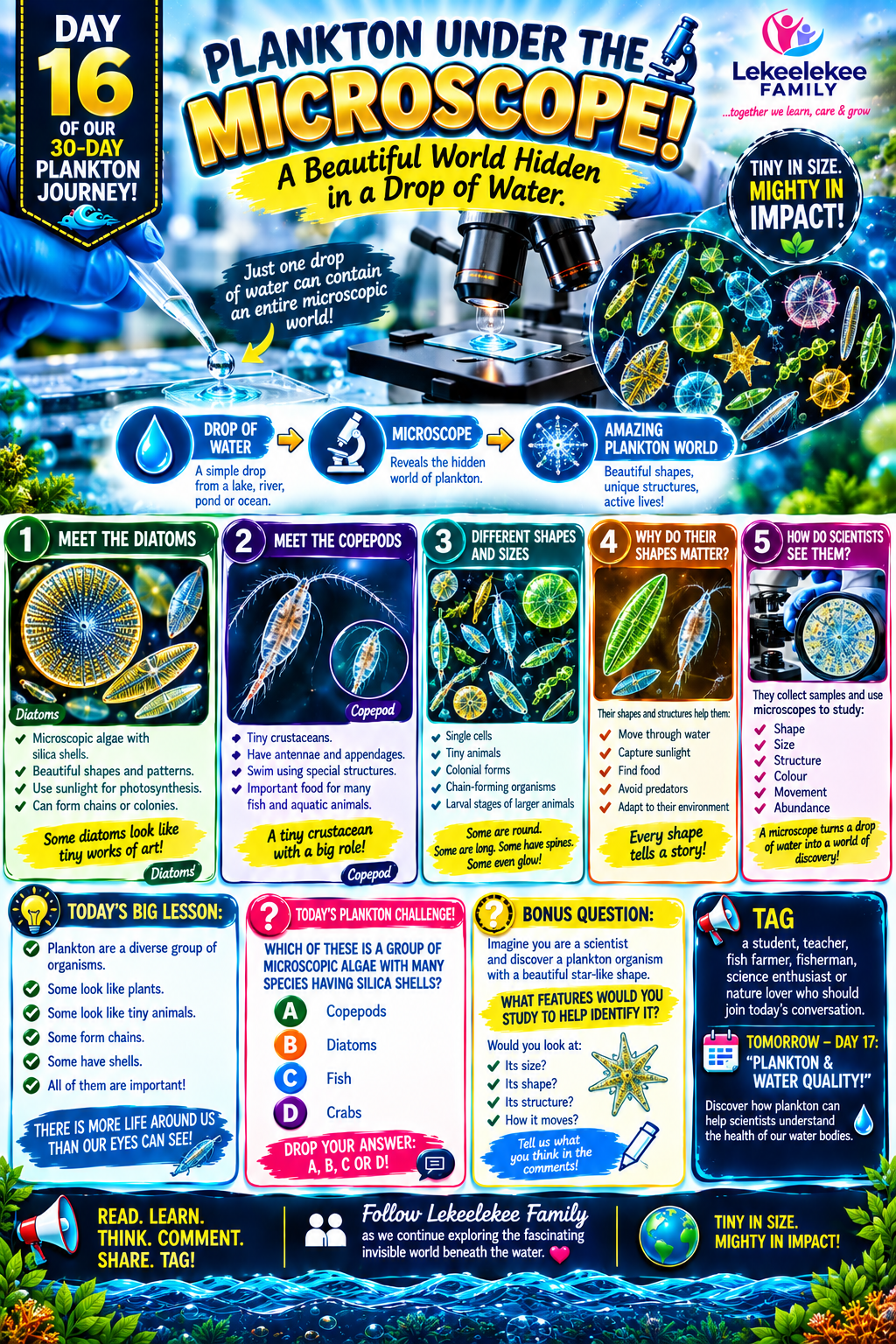
🔬🌱 PLANKTON UNDER THE MICROSCOPE!
A Beautiful World Hidden in a Drop of Water!
Hello, my wonderful Lekeelekee Family! ❤️🌊
Imagine taking just one drop of water from a lake, river, pond or ocean. 💧
To our eyes, it may look like ordinary water.
But place that drop under a microscope…
🤯 WOW! A WHOLE NEW WORLD APPEARS! 🔬✨
Tiny organisms with beautiful shapes, amazing structures and fascinating movements!
Welcome to Day 16, where we explore the microscopic beauty of plankton. 🌊🔬
🔬 1️⃣ MEET THE DIATOMS 🌱
Diatoms are a group of microscopic algae.
Many have beautiful shells made of silica, a material that contains silicon and oxygen.
Their shapes can be:
⭕ Round
🌿 Long and slender
⭐ Star-like
🔗 Chain-forming
🌀 Beautifully patterned
Some diatoms look like tiny glass artworks! 😍
They are important phytoplankton because they use sunlight to make organic matter through photosynthesis.
🌟 FUN FACT:
Some diatoms form chains or colonies, creating fascinating patterns under a microscope.
🦐 2️⃣ MEET THE COPEPODS!
Now let's meet some tiny animal-like plankton! 🦐🔬
Copepods are small crustaceans found in freshwater and marine environments.
Under a microscope, they may look like tiny creatures with:
👀 Antennae
🦵 Appendages
🦐 Segmented bodies
🌊 Swimming structures
They are an important part of many aquatic food webs.
Many fish and other aquatic animals feed on them.
🤔 CAN YOU IMAGINE A TINY CRUSTACEAN SWIMMING IN A DROP OF WATER?
Nature is amazing! ❤️🌊
🌿 3️⃣ PLANKTON COME IN DIFFERENT SHAPES AND SIZES
One of the most fascinating things about plankton is their diversity.
Some are:
🔬 Microscopic single cells
🦐 Tiny animals
🌱 Colonial organisms
🌀 Chain-forming organisms
🐟 Larval stages of larger animals
Some are round.
Some are long.
Some have spines.
Some have beautiful patterns.
Some even glow under special conditions! ✨
THE MICROSCOPIC WORLD IS FULL OF SURPRISES!
🧠 4️⃣ WHY DO THEIR SHAPES MATTER?
Here's a question for our science lovers! 👀
Why don't all plankton look alike?
Their shapes and structures can help them:
🌊 Move through water
☀️ Capture sunlight
🦐 Find food
🛡️ Avoid predators
🔬 Adapt to their environment
For example, some phytoplankton have structures that help them remain suspended in the water.
Some zooplankton have appendages that help them swim.
Every shape tells a story! 🌱🦐
🌊 5️⃣ HOW DO SCIENTISTS SEE THEM?
Remember Day 15?
Scientists collect plankton using:
🧪 Water sample bottles
🕸️ Plankton nets
Then they examine the samples using microscopes.
A microscope helps reveal details that our eyes cannot see clearly.
Scientists can study:
🔬 Shape
📏 Size
🧬 Structure
🌱 Colour
🦐 Movement
📊 Abundance
This helps them identify organisms and understand aquatic ecosystems.
❤️ A MICROSCOPE TURNS A DROP OF WATER INTO A WORLD OF DISCOVERY!
🌟 TODAY'S BIG LESSON:
Plankton are not just tiny dots floating in water.
They are a beautiful and diverse collection of organisms.
Some look like plants.
Some look like tiny animals.
Some form chains.
Some have shells.
Some have amazing structures.
And all of them remind us that:
🌊 THERE IS MORE LIFE AROUND US THAN OUR EYES CAN SEE!
🔬 TINY IN SIZE. MIGHTY IN IMPACT!
🧠 TODAY'S PLANKTON CHALLENGE!
Let's see who gets this one right! 😍👇
WHICH OF THESE IS A GROUP OF MICROSCOPIC ALGAE WITH MANY SPECIES HAVING SILICA SHELLS?
🅰️ 🦐 Copepods
🅱️ 🌱 Diatoms
🅲️ 🐟 Fish
🅳️ 🦀 Crabs
👇 DROP YOUR ANSWER: A, B, C OR D!
🤔 BONUS QUESTION:
Imagine you are a scientist and you discover a plankton organism with a beautiful star-like shape.
WHAT FEATURES WOULD YOU STUDY TO HELP IDENTIFY IT? 🔬
Would you look at:
📏 Its size?
🌿 Its shape?
🧬 Its structure?
🌊 How it moves?
Tell us what you think in the comments! ❤️👇
📢 TAG a student, teacher, fish farmer, fisherman, science enthusiast or nature lover who should join today's conversation.
📌 TOMORROW — DAY 17:
🌱🌊 “PLANKTON & WATER QUALITY!”
We'll discover how plankton can help scientists understand the health of our water bodies.
Don't just scroll past!
READ. LEARN. THINK. COMMENT. SHARE. TAG. ❤️
Follow Lekeelekee Family as we continue exploring the fascinating invisible world beneath the water.
🌊🔬 TINY IN SIZE. MIGHTY IN IMPACT!
#PlanktonJourney #Day16 #Plankton #Microscope #Diatoms #Copepods #Phytoplankton #Zooplankton #AquaticLife #WaterBodies #MarineLife #FreshwaterLife #ScienceForEveryone #EnvironmentalEducation #LekeelekeeFamily #FishFarming #Aquaculture #NatureLovers #ScienceEducation #DidYouKnow #LearnSomethingNew #ProtectOurWaterBodies #Nigeria
0 likes · 0 comments · 0 shares