Post by Dr Esther Nsa Akachukwu (@dr_esther_nsa_akachukwu)
🌊🔬 DAY 15 OF OUR 30-DAY PLANKTON JOURNEY 🔬🌊
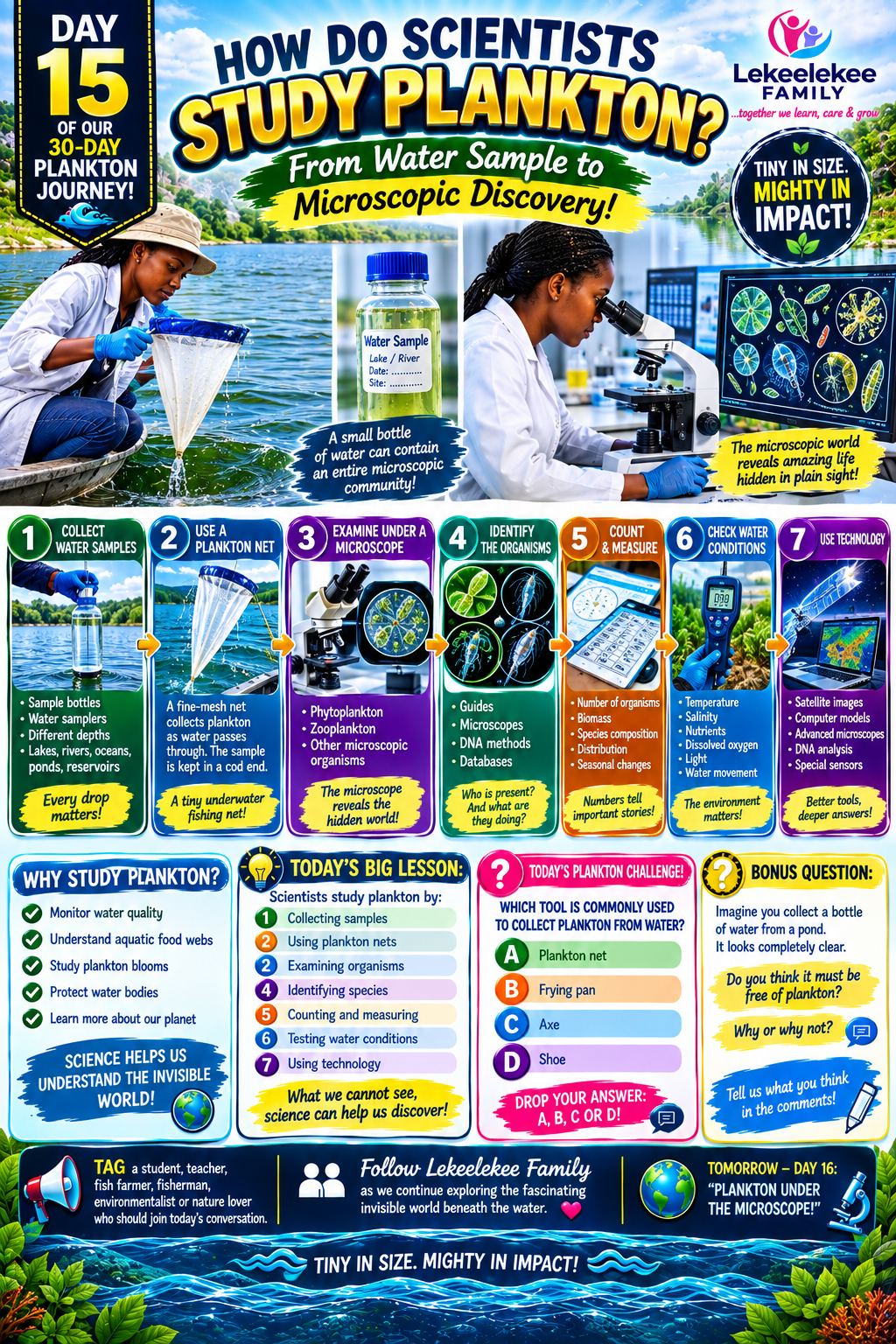
🧪🔍 HOW DO SCIENTISTS STUDY PLANKTON?
Hello, Lekeelekee Family! ❤️🌊
Scientists study plankton by collecting water samples, using plankton nets, examining samples under microscopes, identifying organisms, measuring their abundance, and analyzing water conditions.
🧪 1️⃣ COLLECTING SAMPLES
Scientists collect water from lakes, rivers, ponds, reservoirs, and oceans, sometimes at different depths. Factors such as light, temperature, nutrient availability, and water conditions influence plankton populations.
🦐 2️⃣ USING A PLANKTON NET
A fine-mesh plankton net collects tiny organisms as water passes through it. The sample accumulates in a container called a cod end. Different mesh sizes are used to collect organisms of different sizes.
🔬 3️⃣ USING A MICROSCOPE
Under a microscope, scientists can observe phytoplankton, zooplankton, and other microscopic organisms that cannot be seen with the naked eye.
🧠 4️⃣ IDENTIFYING ORGANISMS
Scientists use microscopes, identification guides, DNA-based methods, and databases to identify organisms such as diatoms, cyanobacteria, copepods, water fleas, and rotifers.
📊 5️⃣ COUNTING AND MEASURING
Scientists estimate plankton abundance, biomass, species composition, distribution, and seasonal variation.
🌡️ 6️⃣ TESTING WATER CONDITIONS
Scientists measure temperature, salinity, nutrient levels, dissolved oxygen, light availability, and water movement because plankton respond to environmental changes.
🛰️ 7️⃣ USING TECHNOLOGY
Satellites, sensors, computer models, advanced microscopes, and DNA analysis help scientists monitor plankton populations and detect potential blooms. However, water samples and laboratory analyses remain essential for accurate identification.
🌟 TODAY'S KEY LESSON
Scientists study plankton by:
🧪 Collecting samples
🦐 Using nets
🔬 Examining organisms
📚 Identifying species
📊 Counting and measuring
🌡️ Testing water conditions
🛰️ Using technology
❤️ SCIENCE HELPS US DISCOVER THE INVISIBLE WORLD!
This knowledge helps scientists monitor water quality, understand aquatic food webs, study algal blooms, and protect aquatic ecosystems.
🧠 TODAY'S PLANKTON CHALLENGE!
WHICH TOOL IS USED TO COLLECT PLANKTON FROM WATER?
🅰️ 🕸️ Plankton net
🅱️ 🍳 Frying pan
🅲️ 🪓 Axe
🅳️ 👟 Shoe
👇 SUBMIT YOUR ANSWER: A, B, C, OR D!
🤔 BONUS QUESTION:
If pond water appears clear, does that mean it contains no plankton? Explain your answer.
📢 Tag a student, teacher, fish farmer, fisherman, science enthusiast, or nature lover.
📌 TOMORROW — DAY 16:
🌊🔬 “PLANKTON UNDER THE MICROSCOPE!”
Follow Lekeelekee Family as we continue exploring the invisible world beneath the water.
🌊🔬 TINY IN SIZE. MIGHTY IN IMPACT!
#PlanktonJourney #Day15 #Plankton #Microscope #PlanktonNet #Phytoplankton #Zooplankton #AquaticLife #WaterQuality #ScienceForEveryone #EnvironmentalEducation #LekeelekeeFamily #Aquaculture #NatureLovers #Nigeria
0 likes · 0 comments · 0 shares