Post by Engr. Olayiwola Adeleke (@Elizcrown)
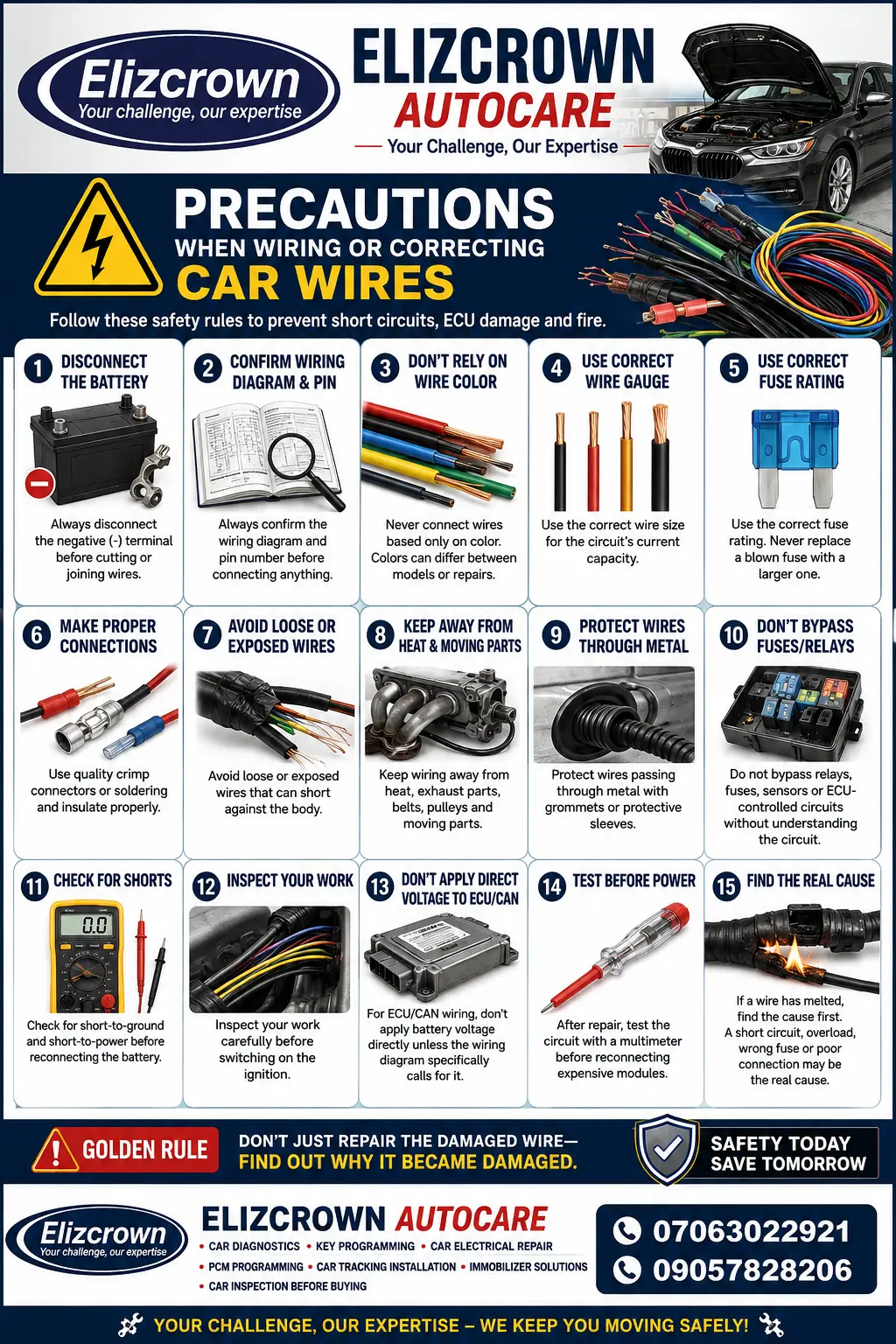
When repairing, extending, or correcting car wiring, these precautions help prevent short circuits, ECU damage, and vehicle fires:
🔧 Car Wiring Precautions
1. Disconnect the battery before cutting or joining wires.
2. Confirm the wiring diagram and pin number before connecting anything.
3. Never connect wires based only on color—colors can differ between models or previous repairs.
4. Use the correct wire gauge for the circuit's current capacity.
5. Use the correct fuse rating; never replace a blown fuse with a larger one.
6. Make proper connections using quality crimp connectors or soldering followed by proper insulation.
7. Avoid loose or exposed wires that can short against the body.
8. AKeep wiring away from heat, exhaust components, belts, pulleys and moving parts.
Protect wires passing through metal with grommets or protective sleeves.
9. Do not bypass relays, fuses, sensors, or ECU-controlled circuits without understanding the circuit.
10. Check for short-to-ground and short-to-power before reconnecting the battery.
11. Inspect your work carefully before switching on the ignition.
12. For ECU/CAN wiring, don't apply battery voltage directly unless the wiring diagram specifically calls for it.
13. After repair, test the circuit with a multimeter before reconnecting expensive modules.
14. If a wire has melted, find the cause first. Simply replacing the wire can result in another fire.
🚨 Golden Rule
Don't just repair the damaged wire—find out WHY it became damaged. A short circuit, overloaded circuit, wrong fuse, poor connection, or damaged component may be the real cause.
0 likes · 0 comments · 0 shares