Post by Udeze Nestor (@Nesmoore1)
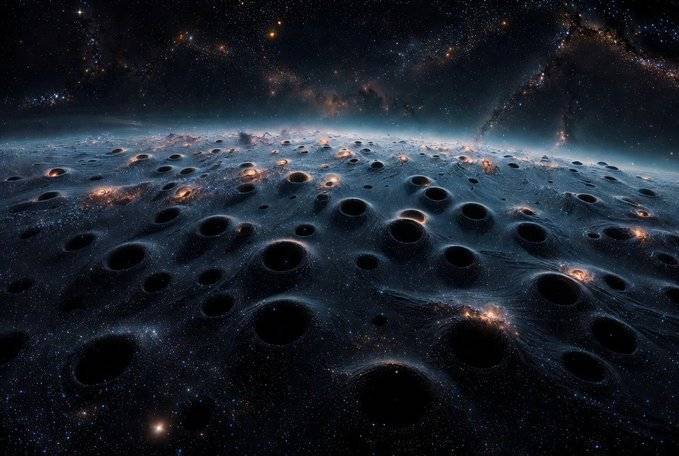
Simulations suggest that more than 90% of the Milky Way’s stellar-mass black holes are loners—isolated objects with no companion star—making the vast majority essentially invisible to current detection methods.
Key findings
Researchers led by Tom Wagg at the Flatiron Institute ran detailed simulations of the Milky Way’s history. They modeled how stars form, evolve, and die over billions of years, including the supernova explosions that create black holes and the powerful “kicks” those explosions can impart.
The results indicate:
About 91% of stellar-mass black holes in the galaxy are currently isolated.
Roughly 3% received strong enough kicks to escape the Milky Way entirely.
Only a small remaining fraction exist in binary systems (the ones astronomers have almost exclusively detected so far).
Because black holes emit no light, isolated ones are extremely hard to find. We normally detect them only through their gravitational effects on a companion star (for example, by watching the star get pulled apart or heated). Without a companion, they leave almost no observable trace.
Why this matters
The black holes we’ve studied so far are a biased, incomplete sample. The simulations imply a large “hidden population” that has been missing from our picture of how black holes form and evolve. This affects models of stellar death, the distribution of black holes in the galaxy, and even estimates of how many should exist overall.
Looking ahead
The team provides predictions for the locations, speeds, and numbers of these isolated black holes. Upcoming observations—especially from the Roman Space Telescope, the next Gaia data release, and various spectroscopic surveys—could reveal some of them through subtler methods such as gravitational microlensing (where a black hole’s gravity briefly bends and brightens the light of a background star).
Paper: Tom Wagg et al., “Charting the Galactic Underworld I: Comprehensive simulations of the kinematics, rates, and demographics of Milky Way black holes,” arXiv (2026). DOI: 10.48550/arxiv.2607.22814.
In short, the galaxy’s black-hole population is probably far lonelier—and far more numerous in its solitary form—than the binaries we’ve been able to observe.
0 likes · 0 comments · 0 shares