Post by Udeze Nestor (@Nesmoore1)
Dark Matter: The Invisible Brake of the Universe
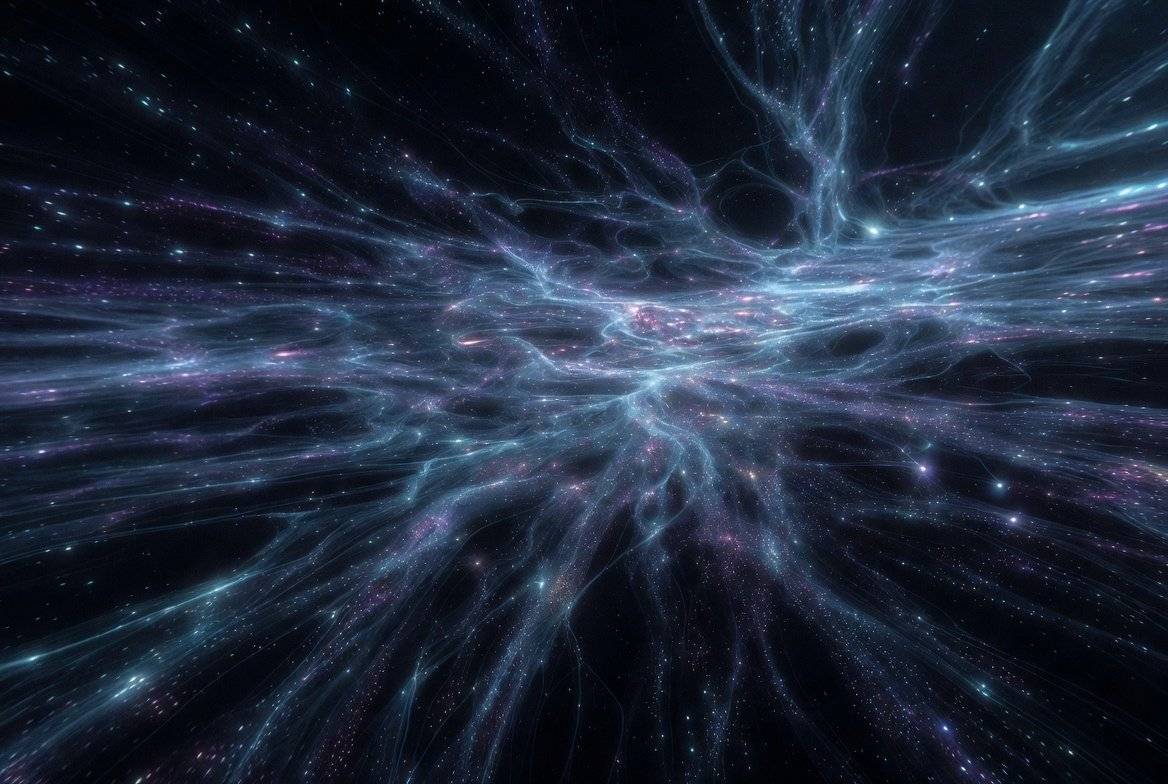
Imagine the cosmic web — that vast network of galaxies and filaments we thought formed through the steady gravitational clumping of matter — is actually slowing itself down. And the culprit? Dark matter.
Researchers at the Perimeter Institute for Theoretical Physics have uncovered a striking paradox. Between the tiny particles of dark matter, there appears to be some hidden attractive force — an extra interaction unknown to standard physics. You’d expect this to speed up the formation of galaxies and massive clusters. Instead, sophisticated computer simulations revealed the opposite: this force causes dark matter to rapidly lose mass as the universe expands.
At first, the particles do clump together more efficiently. But during this process they gradually “lose weight.” As their mass drops, the gravitational pull of these clusters weakens. In the end, the boost from the extra attraction is completely canceled out by the loss of gravitational influence. The growth of large-scale cosmic structures slows down.
This helps explain why observations keep diverging from classical cosmological models: the universe is expanding and building its structure in ways theory didn’t fully anticipate.
The finding carries major implications. Any future theory of dark energy will now have to account for the possibility that dark matter can grow lighter over time. Upcoming space telescopes will either confirm this idea — or quietly file it away among science’s more intriguing near-misses.
Dark matter has reminded us once again: it is not just an invisible backdrop. It actively shapes the fate of the universe — and does so in ways we never expected.
0 likes · 0 comments · 0 shares