Post by Udeze Nestor (@Nesmoore1)
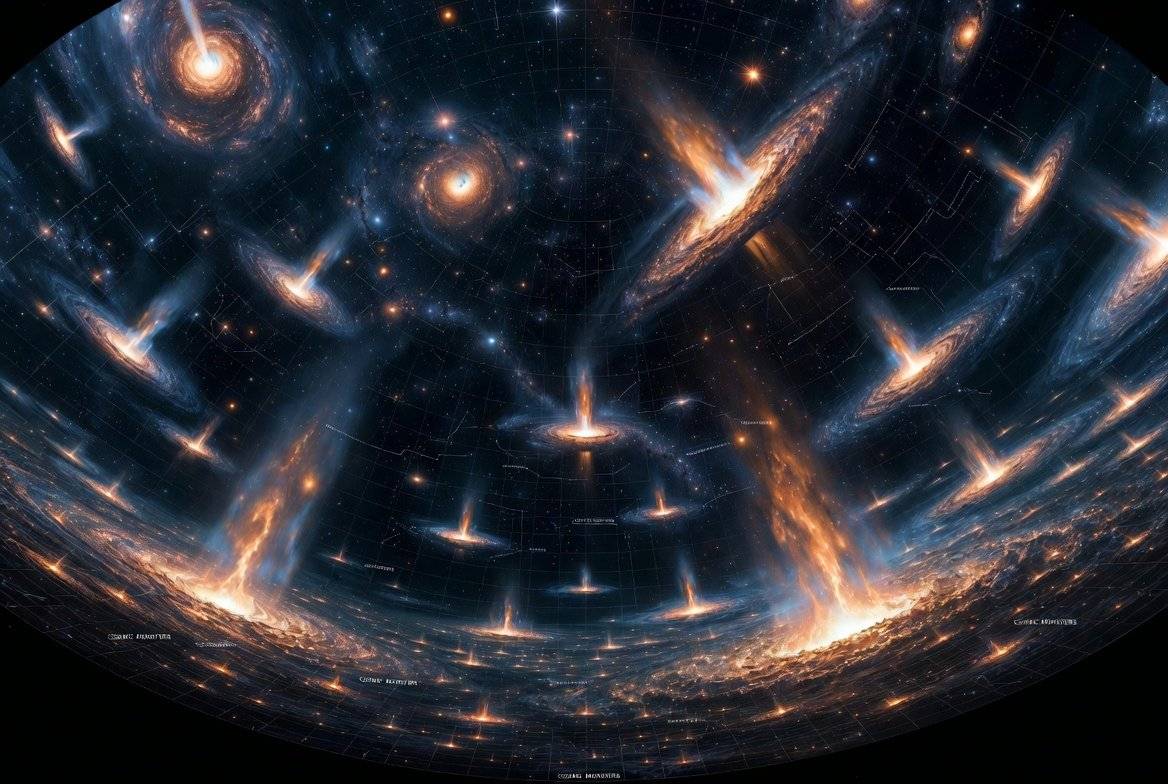
Mapping monsters: new data release reveals all-sky views of supermassive black holes
The Sloan Digital Sky Survey has released Data Release 20, marking a major expansion of its fifth-generation mapping campaign. For the first time, the public dataset includes optical spectra collected by the BOSS instrument at Las Campanas Observatory in Chile. Combined with ongoing observations from Apache Point Observatory in New Mexico, this delivers a true all-sky spectroscopic view of the cosmos.
The full release contains more than 3.3 million optical spectra of roughly 500,000 galaxies and 1.5 million stars. Within it, the Black Hole Mapper program has grown dramatically—three to four times larger than in the previous release—contributing about 1.1 million spectra focused on half a million distinct objects.
A standout feature is the SPIDERS program, which pairs SDSS optical spectroscopy with X-ray maps from the eROSITA space telescope. This effort has produced precise optical identifications and distance measurements for approximately 200,000 X-ray sources, creating the largest uniform follow-up catalog of its kind. Most of these targets are active galactic nuclei and quasars powered by accreting supermassive black holes, along with galaxy clusters and active stars.
The combined X-ray and optical data offer fresh insights into how black holes grew across cosmic history. Researchers found a surprisingly high density of extremely luminous active galactic nuclei at high redshifts near redshift 6, showing that rapidly growing giant black holes were common during the era known as cosmic dawn. At the same time, soft X-ray-selected objects account for only a small fraction of the total black-hole mass in the local universe. This suggests that 70 to 90 percent of black-hole growth occurred either behind thick clouds of gas and dust or during periods when X-ray emission was suppressed.
To study the extreme environments near accretion disks that cannot be imaged directly, SDSS-V employs time-domain spectroscopy. Reverberation mapping involves collecting repeated spectra over time to measure light-travel delays between the central disk and surrounding gas clouds, providing geometric mass estimates for distant black holes. The All-Quasar Multi-Epoch Spectroscopy program further monitors changing-look quasars, potential binary black holes, and powerful gas outflows. The unexpected diversity of these spectra required extensive visual inspections to identify unusual objects missed by automated systems.
These advances are made possible by the Robotic Focal Plane System installed on the 2.5-meter telescopes at both observatories. All Data Release 20 products are freely available to the public through the project’s science and catalog archive servers, along with updated web tools and Jupyter Notebook tutorials designed to support multi-wavelength research worldwide.
0 likes · 0 comments · 0 shares