Post by Udeze Nestor (@Nesmoore1)
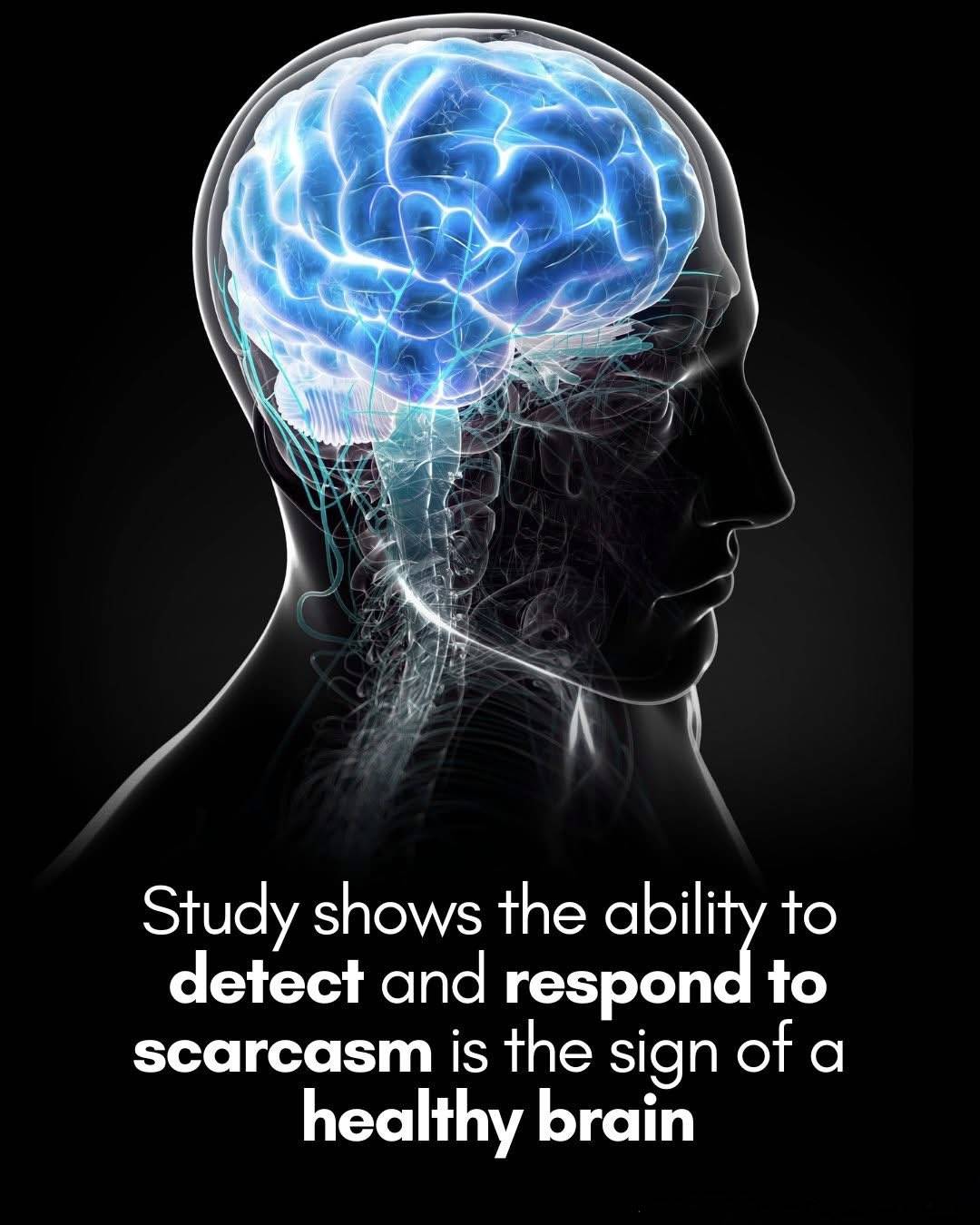
Your ability to understand sarcasm depends on your brain health.
Understanding sarcasm isn’t just a matter of language—it’s a complex social skill deeply rooted in brain biology.
A study published in Neuropsychology reveals that the right prefrontal cortex, a region of the brain associated with emotion and social cognition, plays a critical role in recognizing sarcasm.
Researchers from the University of Haifa and Israel’s Rambam Medical Center tested individuals with different types of brain lesions and found that those with right prefrontal cortex damage had the most difficulty detecting sarcastic intent and interpreting social faux pas. In contrast, participants with no brain lesions or with damage in other brain areas performed significantly better.
The study shows that identifying sarcasm requires more than just hearing the words—it involves empathy and the ability to infer another person’s thoughts and emotions. When participants were asked about a sarcastic remark or a social blunder, only those with intact right prefrontal cortices could consistently grasp the speaker’s intent or understand why something was inappropriate. This research highlights how language, emotion, and social understanding are deeply intertwined in the brain—and how damage in just one area can disrupt our ability to connect with others in everyday conversation.
Reference: Shamay-Tsoory, S., Tomer, R., & Aharon-Peretz, J. (2005). Neuropsychology, Vol. 19, No. 2.
0 likes · 0 comments · 0 shares
Comments
Not sure all the my family members, who think they are qualified physicists would agree with this..but now my annoying sarcasm can be raised by another lever and backe...