Post by Udeze Nestor (@Nesmoore1)
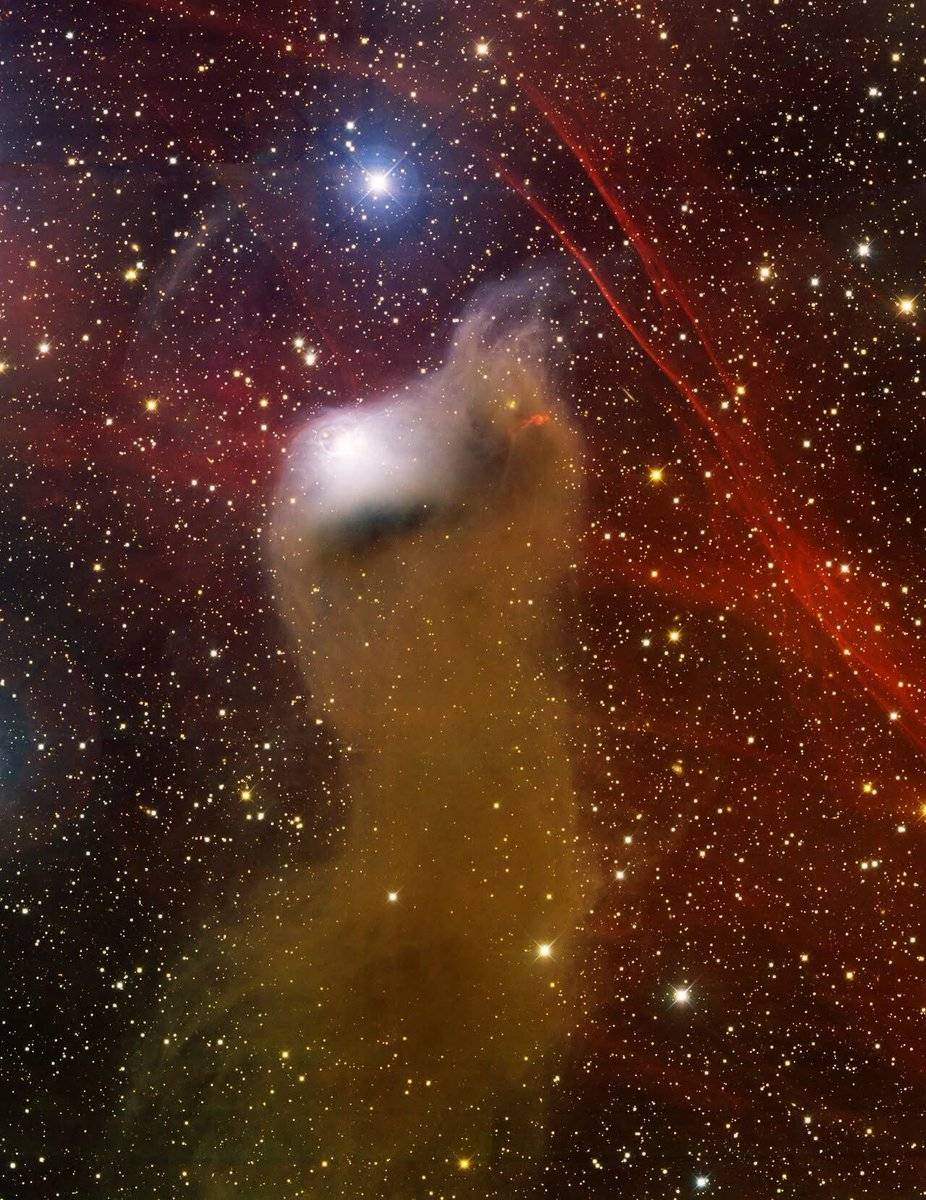
Barnard 175: Where Darkness Meets Newborn Light
In the constellation Cepheus, roughly 1,300 light-years from Earth, a dense cosmic curtain of dust and gas floats against the rich star fields of the northern sky. This is Barnard 175—a classic cometary-shaped Bok globule, one of those isolated, opaque clouds where the raw material of stars is packed so tightly that almost no light escapes.
Resting atop this dark, silhouetted mass is a delicate blue reflection nebula, catalogued as vdB 152 (also known as Ced 201). The glow is not the nebula’s own light, but starlight scattered by fine dust grains. A relatively nearby B9.5V star, BD+69 1231, illuminates the southern edge of the globule, painting the dust in soft, ethereal blue tones and creating one of the most striking contrasts in the Cepheus Flare region: luminous haze perched on pure black.
Look carefully toward the upper right of the scene and a different kind of drama appears. A thin, luminous streamer cuts across the darkness—a Herbig-Haro object known as HH 450. These fleeting features are the visible signatures of powerful jets of gas blasted outward by a very young star still buried deep within the cloud. As the high-speed material collides with the surrounding interstellar medium, it shocks and lights up, briefly tracing the violent birth process of a new star.
Barnard 175 is more than a pretty picture. It is a miniature laboratory of star formation: a dense Bok globule that may one day collapse further to form new suns, a reflection nebula revealing the interplay of light and dust, and a Herbig-Haro jet marking the energetic outflows that accompany stellar infancy. In a single frame we see the quiet persistence of cold molecular clouds and the sudden, brilliant outburst of creation.
Credit: T.A. Rector (University of Alaska Anchorage) and H. Schweiker (WIYN and NOIRLab/NSF/AURA)
0 likes · 0 comments · 0 shares