Post by Udeze Nestor (@Nesmoore1)
Asteroid with strange orbital deviation turns out to be a "dark" comet
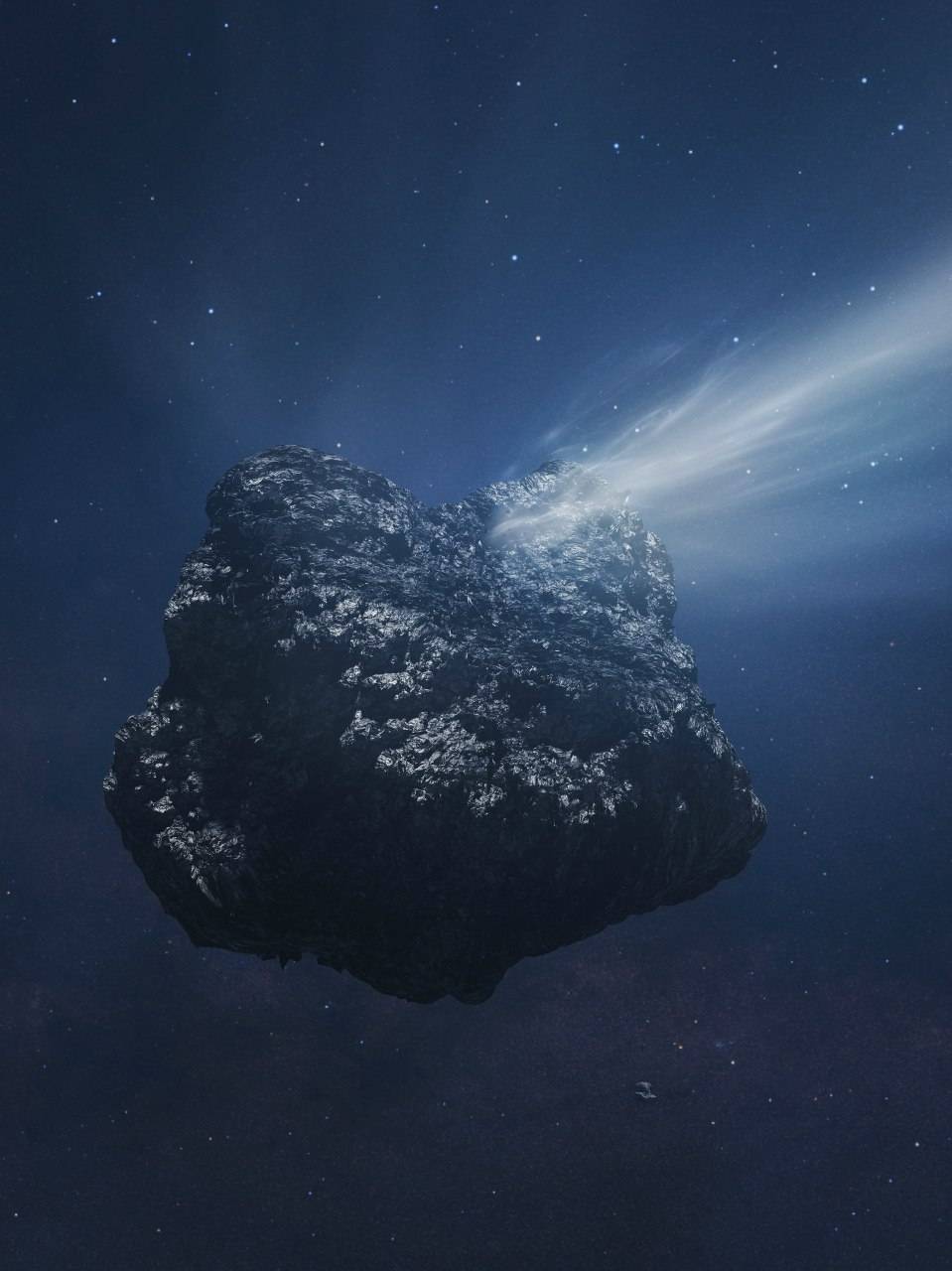
Object 1998 SH2, long considered an asteroid, has turned out to be a low-activity comet. The slow sublimation of its ice generated a reactive thrust that altered its orbit. The comet exhibits a faint coma and a dust tail. Scientists suggest there may be more of these "dark" comets than previously thought—a finding significant for assessing their impact on Earth and studying the origins of water.
Cocoon AI Summary
For nearly 30 years, object 1998 SH2 was classified as an asteroid. In reality, however, it proved to be a comet with low activity. This discovery suggests that there may be far more of these "disguised" comets than previously believed. This is crucial for understanding the origin of water on Earth and assessing the risk of celestial bodies colliding with our planet.
Artist's impression.
Distinguishing between a comet and an asteroid is usually straightforward. Comets contain ice that begins to sublimate as they approach the Sun, forming a coma—a cloud of gas and dust—and a characteristic tail. Asteroids lack these features. In recent years, however, scientists have increasingly discovered objects that combine the properties of both groups. Some look like ordinary asteroids, yet their motion cannot be explained by gravity alone.
This is precisely what happened with the celestial body 1998 SH2. During its close approach to Earth in 2025, astronomers found it was significantly far from its predicted location. An analysis of observational data collected since the object's discovery revealed non-gravitational acceleration.
Initially, researchers hypothesized that the Yarkovsky effect—a weak force resulting from the uneven thermal radiation of a heated surface—was responsible. However, calculations showed that the acceleration was approximately ten times greater than the maximum possible value.
The most likely explanation was the slow sublimation of ice. As water molecules escape the surface of the celestial body, they generate a weak reactive thrust that gradually alters its orbit. Estimates suggest that 1998 SH2 ejects roughly 1.2 × 10²⁴ water molecules per second. Detecting such activity during observations is incredibly difficult, yet it is sufficient to alter the object's trajectory over the course of decades.
To test this hypothesis, astronomers conducted further observations using large ground-based telescopes. While initial images from the ATLAS telescope network revealed nothing unusual, more sensitive instruments detected a faint coma and a thin dust tail. Consequently, the object was officially designated as comet P/1998 SH2, while retaining its asteroid designation.
Image analysis revealed that the tail consists primarily of large dust particles, measuring approximately 400 micrometers. It appears that the ice lies beneath a surface layer of dust, meaning active sublimation begins only after a delay following peak solar heating. Scientists attribute the long-standing lack of observed cometary activity to this phenomenon.
This marks the first time a "dark comet" has been confirmed through direct observation. The authors of the study, published in *Nature Astronomy*, suggest that other low-activity comets may be hiding among known near-Earth asteroids.
If such objects are indeed numerous, their orbits could shift more significantly than previously anticipated—a factor that must be considered when assessing potential threats to Earth. Studying dark comets will also provide insight into the role of ice-rich bodies in delivering water to the early Earth.
0 likes · 0 comments · 0 shares