Post by Udeze Nestor (@Nesmoore1)
🌌 THE LARGEST STRUCTURE IN THE KNOWN UNIVERSE?
Picture something so vast that a beam of light—racing at nearly 300,000 kilometers every second—would still take billions of years to cross from one end to the other.
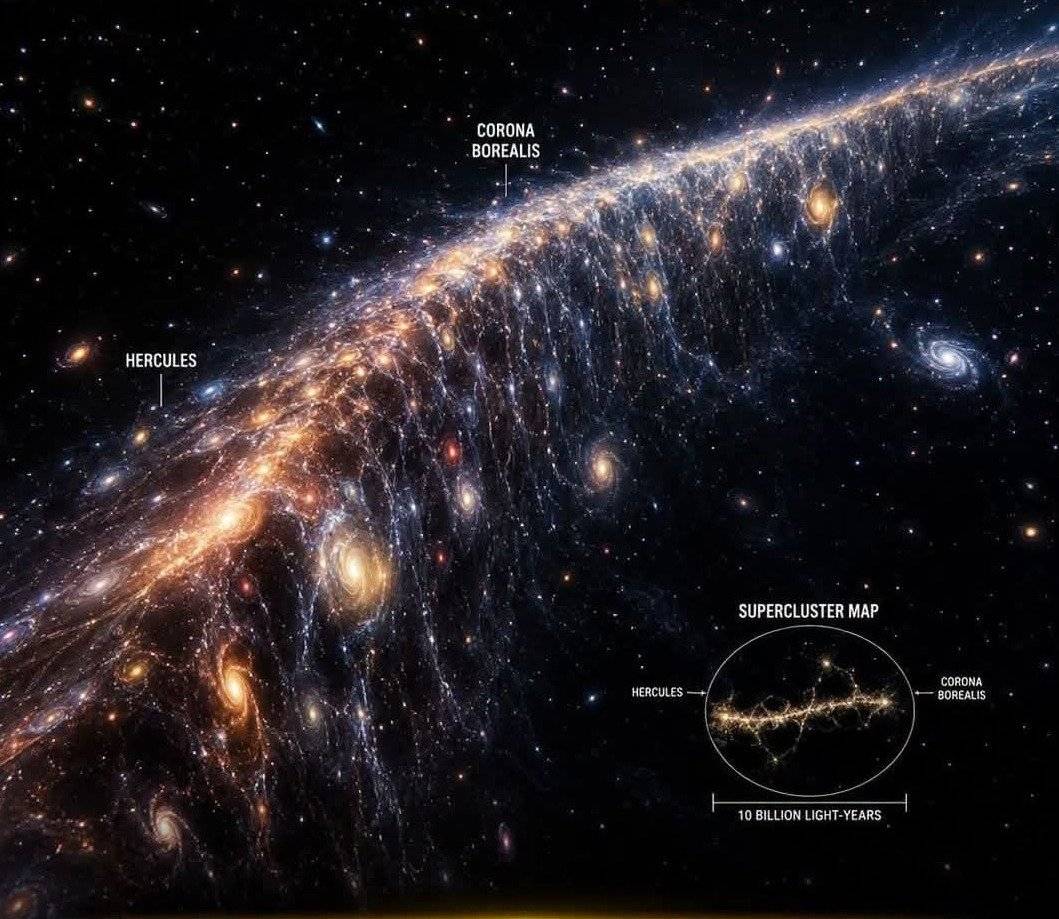
That something is the Hercules–Corona Borealis Great Wall, currently one of the largest known structures in the observable universe.
Don’t picture a solid barrier. This “wall” is a colossal filament of the cosmic web: a sprawling concentration of galaxies, galaxy clusters, and dark matter stretched across an estimated 10 billion light-years.
Astronomers first spotted it in 2013 while mapping gamma-ray bursts—the most violent explosions in the cosmos. An unexpected clustering of these distant beacons revealed a gigantic overdensity of matter spanning roughly one-tenth the diameter of the entire observable universe.
For scale: our Milky Way is about 100,000 light-years across. The Hercules–Corona Borealis Great Wall is roughly 100,000 times larger.
Its sheer size poses a serious challenge to the cosmological principle, which assumes that on the largest scales the universe should look roughly the same in every direction. Most models predicted that coherent structures shouldn’t grow much beyond about 1.2 billion light-years. This one appears to smash that limit.
Researchers continue to debate whether it is a single, truly connected structure or a statistical alignment of smaller clusters. Either way, it ranks among the most mind-bending discoveries in modern cosmology.
The universe is not a random scattering of stars and galaxies. It is woven into patterns so immense they defy everyday imagination—and somewhere inside this gargantuan wall of galaxies floats our own tiny Milky Way, a humble reminder of just how small our place in the cosmos really is.
0 likes · 0 comments · 0 shares