Post by Ogba Heritage TV (@Heritagetv)
Who is Who in Ali-Ogba Series.
(Episode 001)
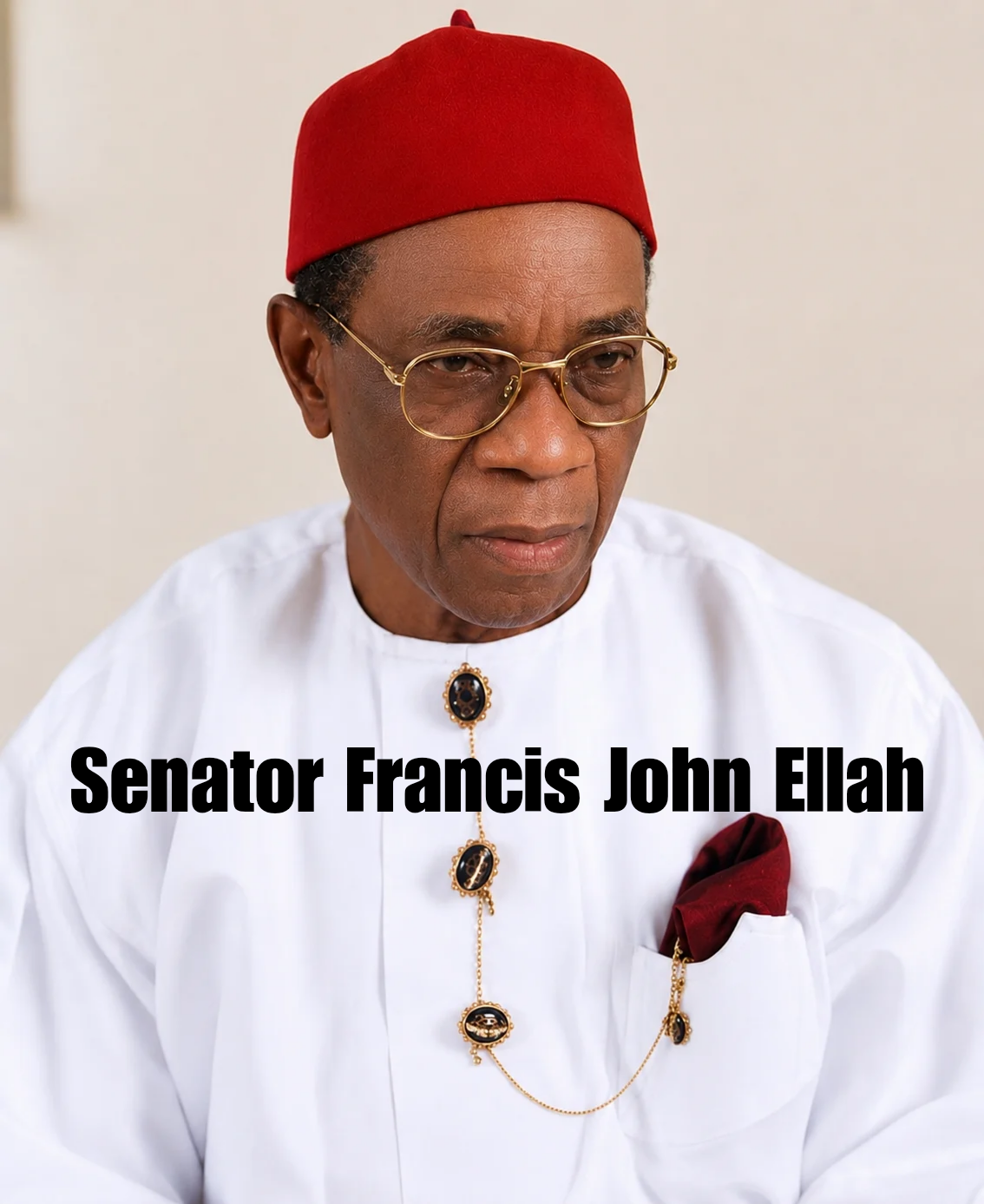
Senator Francis John Ellah (1927–2008)
The Civil Servant Who Chose Principle Over Power.
Francis John Ellah belongs to the generation of Nigerian public servants who helped bridge the colonial and post-independence eras.
His contributions span public administration, diplomacy, higher education, legislative politics, private enterprise, and historical scholarship. His resignation from the Senate remains an enduring example of political conviction, while Ali Ogba: A History of the Ogba People established an important foundation for the written documentation of Ogba history. His legacy continues to influence discussions on governance, identity, and the preservation of cultural heritage in Ali-Ogba and beyond.
Introduction
On a day in 1981, Senator Francis John Ellah walked away from one of the highest political offices in Nigeria. He was not removed by the courts, defeated at the polls, or forced out by scandal. Instead, he resigned voluntarily from the Nigerian Senate because he believed the chamber had denied him the constitutional right to present a motion advocating the creation of additional states. In choosing principle over political office, he made a decision that remains one of the rarest demonstrations of legislative integrity in Nigeria's democratic history.
That singular act has often defined public memory of Francis John Ellah. Yet it tells only part of his story.
Long before he entered elective politics, Ellah had established himself as one of Nigeria's most accomplished public administrators. He served as a teacher, colonial administrator, diplomat, senior civil servant, Permanent Secretary, Registrar of the Rivers State University of Science and Technology, and later as Secretary to the Military Government and Head of the Rivers State Civil Service during the formative years of the state. Beyond government, he became an industrialist, author, and one of the earliest Ogba scholars to document the history of his people in a comprehensive published work.
His life mirrored the evolution of modern Nigeria. Born during the colonial era, educated in some of the country's finest institutions, and entrusted with responsibilities at home and abroad, Ellah participated in many of the defining moments of twentieth-century Nigeria. He witnessed the transition from colonial administration to independence, contributed to governance during the post-civil war reconstruction, and played a significant role in building the institutions of the newly created Rivers State.
For the people of Ali-Ogba, however, his legacy extends beyond public office. Through his book Ali Ogba: A History of the Ogba People, he sought to preserve the history, traditions, and identity of his homeland in written form. Although some of his interpretations have generated scholarly debate, the work remains one of the most influential publications ever written on Ogba history and continues to serve as an essential reference for researchers of the Niger Delta.
Francis John Ellah belonged to a generation that regarded education as preparation for service and leadership as a responsibility rather than a privilege. Throughout a career spanning more than five decades, he combined scholarship with administration, public service with enterprise, and intellectual curiosity with a deep commitment to his ancestral homeland.
This biography examines the life of a man whose contributions reached far beyond the offices he occupied. It traces the journey of an Omoku-born scholar who helped shape public administration in Eastern Nigeria and Rivers State, represented Nigeria abroad, defended his convictions in the Senate, invested in agriculture, and left behind a body of historical writing that continues to influence discussions on the origins and identity of the Ogba people.
In telling his story, we also gain insight into the history of Ali-Ogba, the development of Rivers State, and the enduring impact that principled leadership can have on a community and a nation.
#ogbaheritagetv #AliOgba #goviral #CulturalHeritage #africa
0 likes · 0 comments · 0 shares