Post by Ceejay Oji (@CeejayOji)
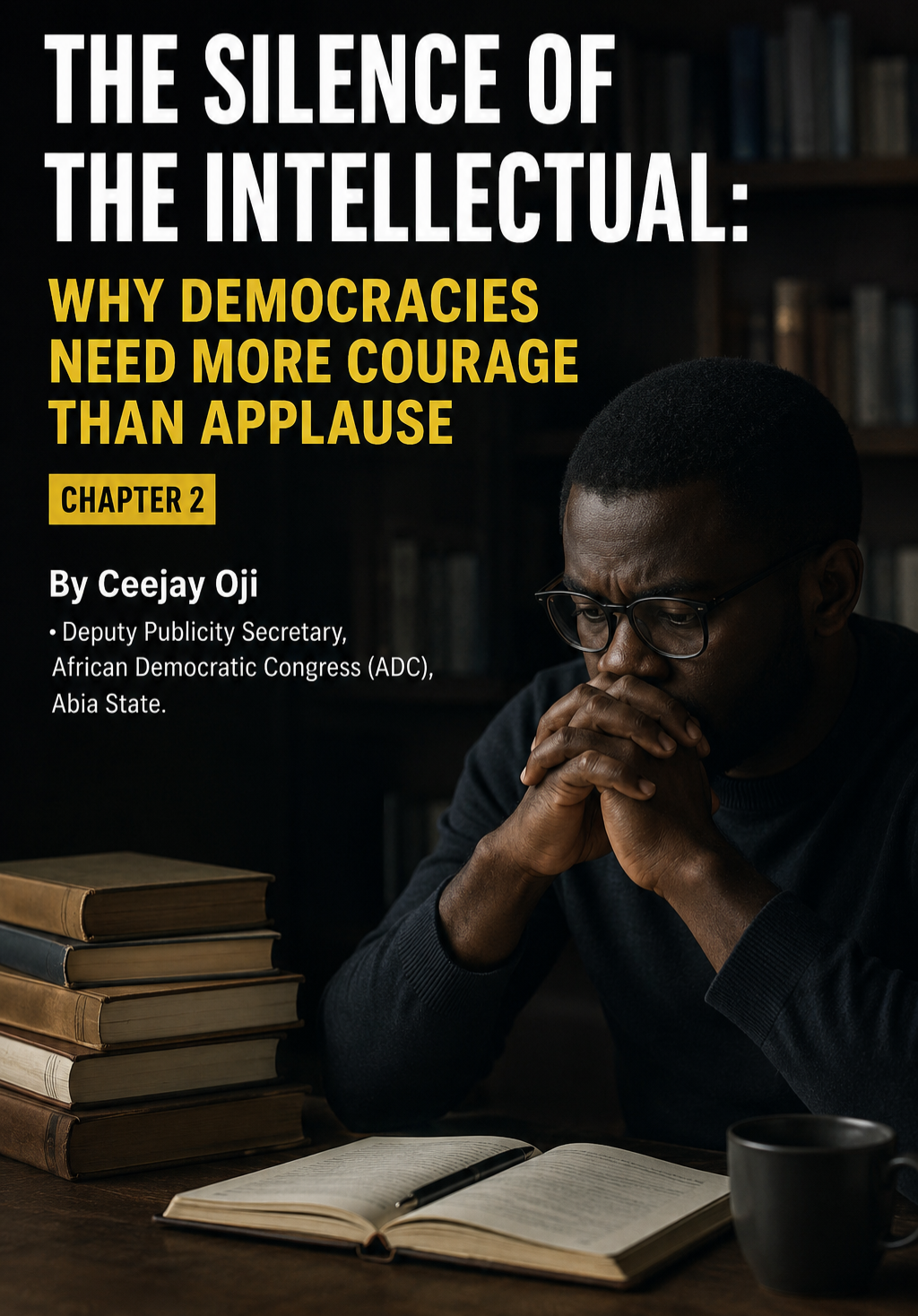
THE SILENCE OF THE INTELLECTUAL
WHY DEMOCRACIES NEED MORE COURAGE THAN APPLAUSE (CHAPTER 2)
By Ceejay Oji
• Deputy Publicity Secretary, African Democratic Congress (ADC), Abia State.
If you're just joining this series, I strongly recommend reading Chapter One first. It provides the foundation for this discussion.
Read Chapter One here:
https://lekeelekee.com/post/019fa8b9-e2ad-70ad-be7c-720da08407fc
In Chapter One, we established that democracy depends not only on those who govern but also on citizens who are willing to question power when necessary. We also saw that when informed voices withdraw, propaganda, misinformation, and blind loyalty quickly fill the vacuum.
The next question is obvious. If intellectuals understand the importance of truth and accountability, why do so many remain silent?
Not every issue demands public commentary, and not every intellectual must become a political activist. Wisdom often requires restraint. But there are moments when justice, accountability, constitutional principles, and the welfare of the people are at stake. At such moments, prolonged silence is no longer neutrality. It becomes a failure of civic responsibility.
One reason many intellectuals remain silent is the hostility directed at independent thought. In many African democracies, including Nigeria, those who ask legitimate questions about governance are often branded enemies of government, dismissed as perpetual critics, or accused of opposing progress. Instead of addressing their arguments, society attacks their motives. Debate gives way to partisanship, and reason is replaced with political loyalty.
The result is predictable. Many intellectuals calculate the personal cost of speaking. Some protect their careers. Others avoid harassment and abuse. Gradually, applause becomes safer than honesty, and conformity becomes more rewarding than independent thought.
History tells a different story. Many of the people who transformed societies were resisted in their own time because they challenged accepted ideas. Today they are remembered not for preserving comfort but for defending truth. Every society must distinguish between destructive cynicism and constructive criticism. One seeks to destroy. The other seeks improvement.
Questioning government is not opposition. Asking whether public resources are used wisely is not sabotage. Demanding transparency is not hatred. Evaluating policies by results rather than publicity is not disloyalty. These are the duties of responsible citizens.
Democracy was never designed to survive on elections alone. Elections determine who governs, but accountability determines how they govern. Between elections, citizens, journalists, lawyers, religious leaders, professionals, and scholars must ensure that public office remains an instrument of service rather than a shield against scrutiny.
Governments deserve praise when they perform well. Genuine achievements should be celebrated. But praise should never replace critical judgment. Strong democracies make room for both commendation and criticism because accountability is one of the highest expressions of patriotism.
Our societies have long respected those who speak truth without fear or favour. That tradition should not disappear because politics has become more polarized. Intellectual independence means praising what is right, rejecting what is wrong, and remaining consistent regardless of who holds power.
Every generation is judged not only by its leaders but also by the citizens who either challenged or enabled them. Future generations will ask whether those with knowledge chose conviction over convenience and defended principles above personalities.
The answers are being written today.
As Nigeria continues its democratic journey, our nation needs more than louder voices. It needs credible voices, principled reasoning, and citizens whose loyalty is first to truth, justice, constitutionalism, and the common good.
The silence of the intellectual may provide temporary comfort, but history shows that societies pay a heavy price when those who know better choose applause over honesty. Democracy flourishes where truth is defended without fear and where power is reminded that it remains accountable to the people.
A society should never fear the voice of its intellectuals. It should fear the day they decide that speaking the truth is no longer worth the cost.
Now, over to you.
Do you think intellectuals in Nigeria, especially Abia State, are doing enough to hold those in power accountable?
Have we reached a point where asking genuine questions automatically makes someone an enemy of government?
Or do you think the problem lies elsewhere?
Please share your thoughts.
0 likes · 0 comments · 0 shares