Post by Udeze Nestor (@Nesmoore1)
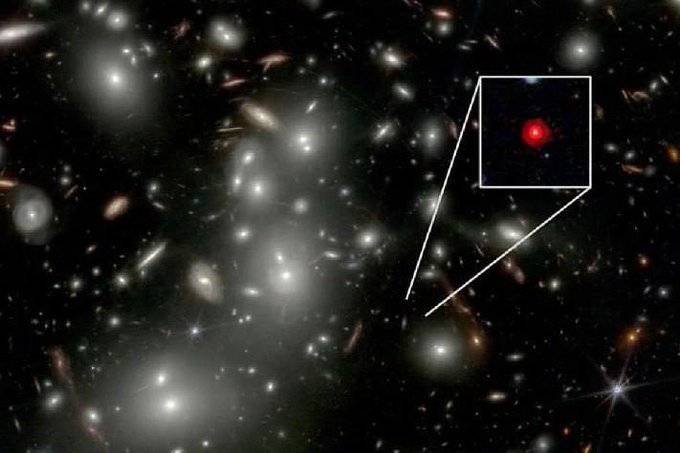
Webb Discovers Oldest Black Hole
Using the Webb telescope, astronomers have discovered a supermassive black hole, QSO1, whose light has traveled to Earth for over 13 billion years. We observe it as it existed when the Universe was less than 700 million years old. Its mass is estimated at approximately 50 million solar masses—a figure that challenges standard models, which posit that such objects grow slowly following the death of stars. It is also unusual that QSO1 appears largely detached from a host galaxy, given that supermassive black holes are generally thought to form at galactic centers.
Scientists hypothesize that QSO1 could be a primordial black hole—a type of object whose existence was predicted by Stephen Hawking in the 1970s. Such objects may have formed in the immediate aftermath of the Big Bang through the collapse of dense regions of spacetime. The composition of the material surrounding QSO1 points to primordial hydrogen and helium devoid of heavy elements, supporting the theory of a "pre-stellar" origin. If confirmed, this discovery would reshape our understanding of how the Universe's first structures formed and provide a crucial means of testing fundamental laws of physics.
0 likes · 0 comments · 0 shares