Post by Zino (@FortyForty)
A few days ago, I watched a lawyer stand before an appeal court and receive the kind of 'dressing down' no legal professional ever wants.
The court had discovered that parts of his submission cited cases and court decisions that simply didn't exist.
Not obscure cases. Not overturned cases.
They had never existed.
The explanation?
He had relied on AI.
I wish I could say I was surprised.
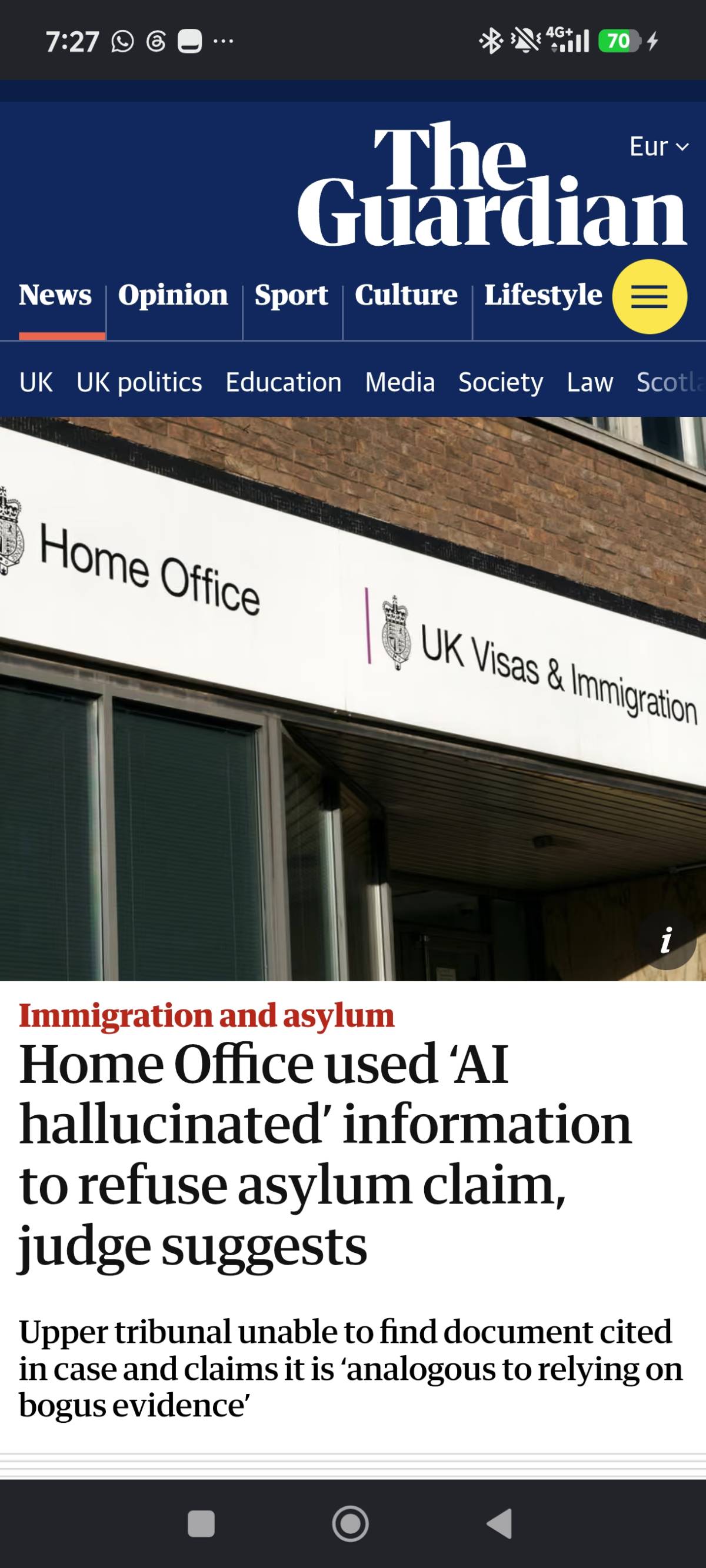
Not long before that, I read a report in The Guardian about an asylum seeker in the UK whose application was rejected after an AI system reportedly relied on a document that didn't even exist. Think about that for a second. A person's future hanging on evidence that was essentially a figment of a machine's imagination.
Stories like these are becoming less shocking and more familiar.
And that's what worries me.
Now, before anyone accuses me of being anti-AI, let me save you the trouble.
I'm probably one of its biggest cheerleaders.
I use AI almost every day. It has transformed the way I work. If you know me, you'll know I enjoy getting lost in data, finding patterns, connecting dots, analysing trends and turning raw information into something useful. AI has become an incredible companion for that. Tasks that used to swallow half a day can now be done before I've finished a cup of hot chocolate (since I don't drink coffee)
It's brilliant.
But somewhere along the way, we've quietly changed the relationship.
AI was supposed to be the assistant.
Instead, many people have promoted it to manager.
We've stopped asking, "Is this right?" and started asking, "What did ChatGPT say?"
That's a dangerous shift.
Every AI platform tells you, in one way or another, that it can make mistakes. It can misunderstand context. It can confidently invent facts. It can fabricate sources. The warning has always been there.
Ironically, the only one who seems to ignore that warning is the human using it.
We've become so impressed by how quickly AI produces answers that we've forgotten one important detail.
Fast isn't the same as correct.
Confident isn't the same as accurate.
And intelligence isn't the same as judgement.
The best professionals I've ever worked with all had one thing in common. They questioned everything. They challenged assumptions. They looked for gaps. They didn't stop thinking just because they had an answer.
That's exactly what AI should encourage us to do, not replace it altogether.
Because if we lose the habit of thinking for ourselves, we lose what makes us human.
And that would be the most unnecessary own goal of the digital age.
So, what do you think? Has AI made us more productive... or has it quietly made us a little intellectually lazy?
#ArtificialIntelligence #AI #CriticalThinking #Leadership #FutureOfWork #Innovation #DigitalTransformation #HumanJudgement #LegalTech #DataAnalytics #Technology #Productivity #GenerativeAI #Lekeleke
0 likes · 0 comments · 0 shares