Post by Student_Nurse Eno Wellington (@eno_wellington)
Causes & Inheritance of Sickle Cell Disease
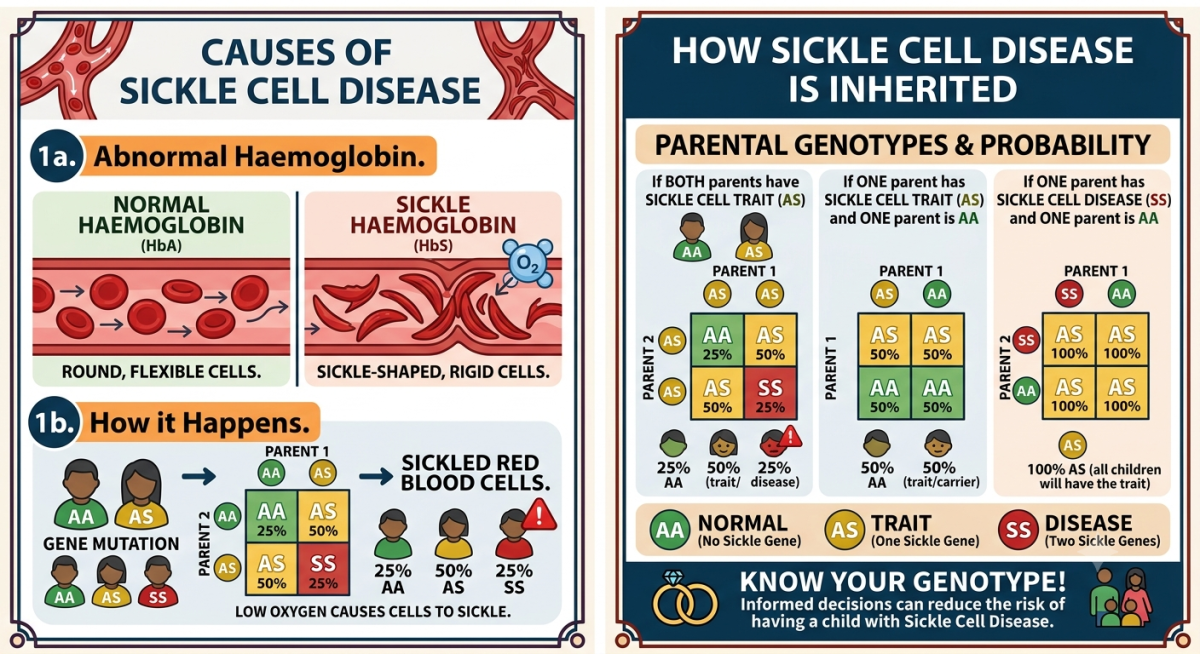
Sickle Cell Disease (SCD) is a condition that happens because of a change (mutation) in the gene responsible for producing haemoglobin — the substance in red blood cells that carries oxygen around the body.
This genetic change causes the body to produce an abnormal type of haemoglobin called haemoglobin S (HbS). When oxygen levels become low, red blood cells containing HbS can change from their normal round shape into a sickle or crescent shape. These sickle-shaped cells are less flexible and can block blood vessels, leading to pain crises, anaemia, and other health complications.
How Sickle Cell Disease is Inherited
Sickle Cell Disease is passed from parents to children through genes. A child receives one haemoglobin gene from the mother and one from the father.
AA (Normal genotype): The person does not have sickle cell disease and does not carry the sickle cell gene.
AS (Sickle cell trait/carrier): The person carries one sickle cell gene but usually does not have the disease. They can pass the gene to their children.
SS (Sickle Cell Disease): The person inherited two sickle cell genes (one from each parent) and has the disease.
For a child to have SS (sickle cell disease), both parents must pass the sickle cell gene. This is why knowing your genotype before marriage and having children is very important.
Understanding your genotype helps you make informed decisions and reduces the risk of having a child with sickle cell disease.
#sicklecellawareness
0 likes · 0 comments · 2 shares