Post by Ceejay Oji (@CeejayOji)
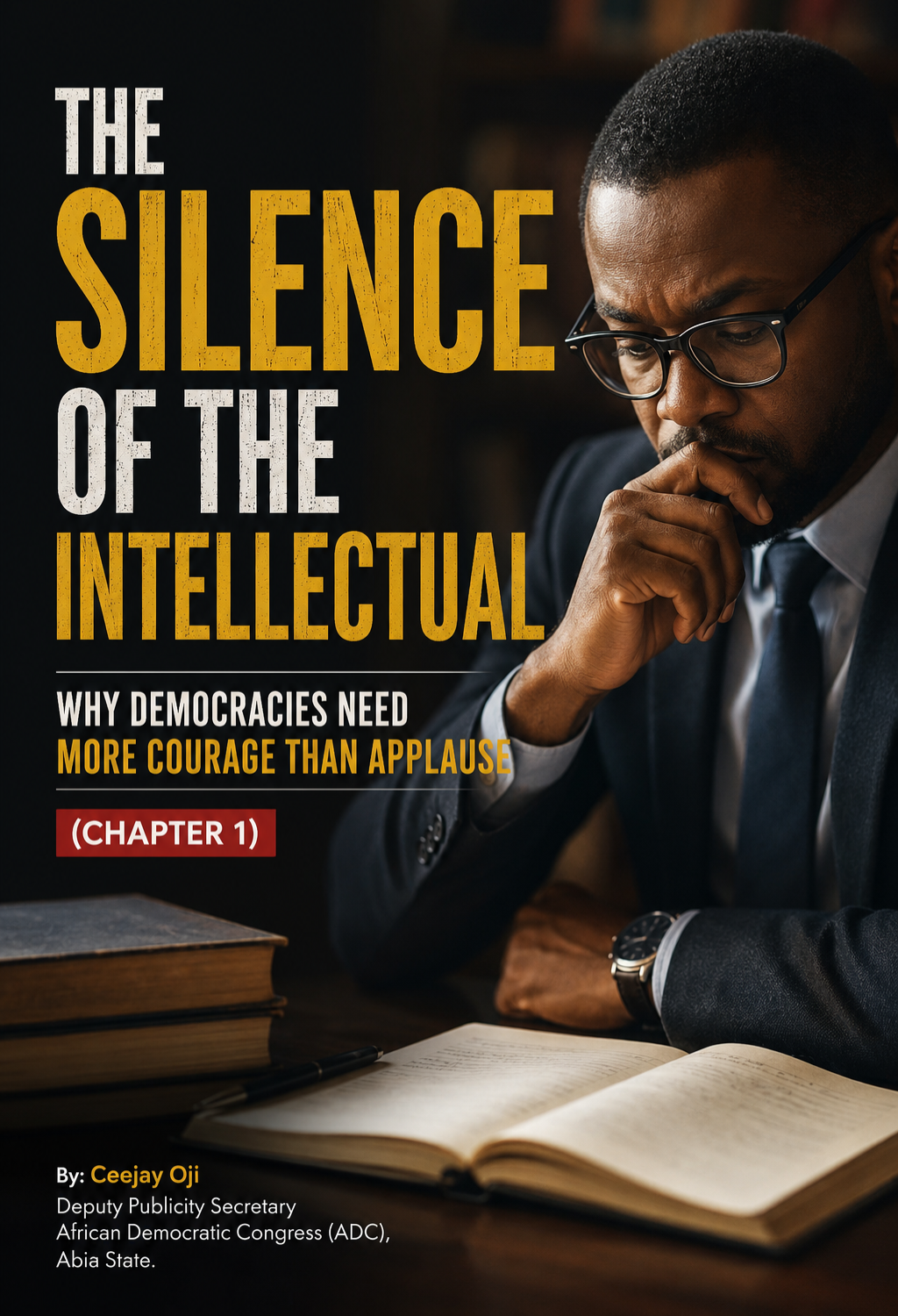
THE SILENCE OF THE INTELLECTUAL: WHY DEMOCRACIES NEED MORE COURAGE THAN APPLAUSE (CHAPTER 1)
By: Ceejay Oji
• Deputy Publicity Secretary, African Democratic Congress (ADC), Abia State.
Every society depends on different kinds of people for its progress. Some cultivate the land, heal the sick, defend the nation, or administer government. Yet another group plays an equally indispensable role, though its influence is often less visible. These are the intellectuals: academics, lawyers, journalists, writers, researchers, professionals, clergy, policy analysts, and public thinkers whose responsibility extends beyond their occupations to the pursuit of truth and the defence of the public interest.
An intellectual is not simply someone with degrees or prestigious titles. Education alone does not make one an intellectual. What distinguishes the true intellectual is integrity, moral courage, and a commitment to reason. Such people question assumptions, challenge falsehoods, scrutinize those in authority, and defend what is right even when it comes at personal cost.
Africa's history is filled with individuals who refused to allow truth to bow before power. Dr. Nnamdi Azikiwe inspired generations through his advocacy for self determination and nation building. Kwame Nkrumah championed African unity. Julius Nyerere emphasized principled leadership. Thomas Sankara challenged dependency and injustice. Chinua Achebe confronted uncomfortable truths about leadership, while Wole Soyinka reminded us that loyalty to one's country must never be confused with loyalty to those temporarily in power. Chief Gani Fawehinmi defended constitutionalism despite immense sacrifices. Nelson Mandela showed that justice often demands sacrifice, and Professor PLO Lumumba continues to challenge Africans to reject corruption, mediocrity, and intellectual complacency.
What united these figures was not political affiliation but the conviction that truth must never become subordinate to power.
One of the greatest threats to democracy is not merely bad leadership. Nations can recover from poor leaders. What is far more difficult to overcome is the silence of those with the knowledge and credibility to expose errors before they become disasters.
When intellectuals fall silent, society loses one of its strongest systems of accountability.
That silence is not always forced. It may be purchased through political patronage or sustained by tribal, ethnic, or religious loyalties, financial dependence, career ambitions, or the desire to remain in the good graces of those in power. Sometimes it is simply driven by fear of public attacks or professional isolation.
Whatever the reason, the result is the same. Misinformation fills the vacuum. Propaganda flourishes where critical thinking is absent. Praise becomes more abundant than evidence, emotion replaces reason, and political loyalty begins to outweigh objective judgment.
A society where applause consistently drowns out honest criticism gradually loses its capacity for self correction.
Today, patriotism is too often measured by the willingness to applaud rather than the courage to question. The scholar who asks difficult questions is branded a cynic. The lawyer demanding constitutional accountability is labelled anti government. The journalist investigating public affairs is accused of hidden motives. Even ordinary citizens who raise genuine concerns are pressured into silence.
The easiest way to weaken a democracy is not to imprison every critic but to convince society that every critic is an enemy.
Democracy does not require unquestioning loyalty. It requires informed participation. Citizens must be willing to commend what deserves praise and question what demands explanation. Genuine progress is strengthened, not threatened, by scrutiny.
The decline of a society rarely begins with a shortage of educated people. More often, it begins when educated people become unwilling to use their knowledge in the service of truth. Degrees may decorate our walls, but without courage they cannot transform a nation.
Yet one question remains. If intellectual silence is so costly, why do those with knowledge and influence still choose it? Is it fear, convenience, political loyalty, or has our democracy become increasingly intolerant of independent thought?
These questions deserve careful examination.
In Chapter Two, we shall explore why many intellectuals choose silence, why critics are often branded enemies of government, and why democracy pays a heavy price whenever truth becomes inconvenient.
Feel free to share your thoughts.
0 likes · 0 comments · 1 shares