Post by Jeph Anne (@jephanne24)
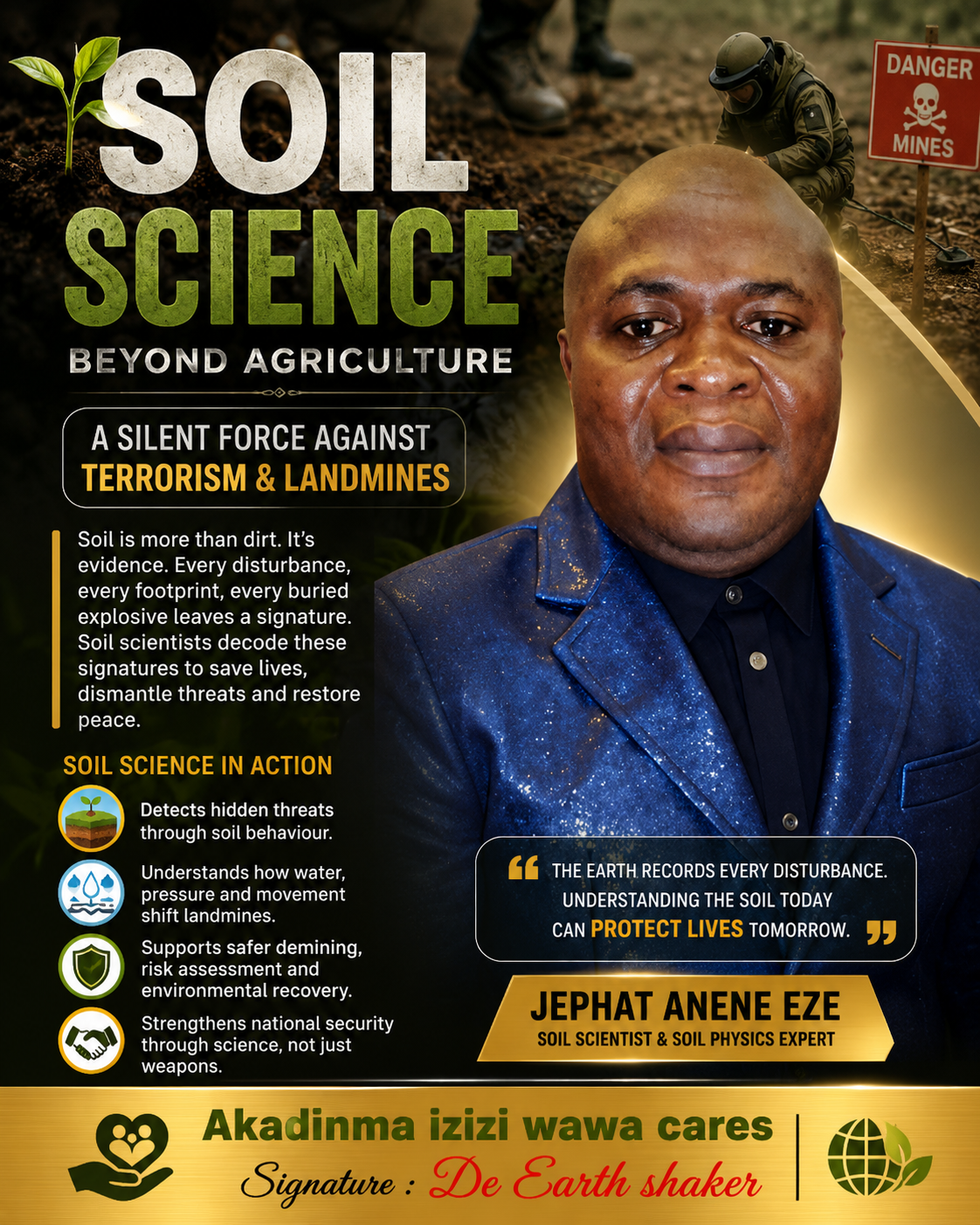
Beyond Agriculture: Why Soil Scientists Should Be at the Frontline of Counter-Terrorism
When people hear the words soil scientist, they often think of farming, fertilisers, or crop production. Yet beneath every battlefield, every border crossing, every terrorist hideout, and every conflict zone lies one common denominator: the soil.
The ground is more than dirt. It is a silent witness. Every footprint, every buried explosive, every tunnel, every hidden cache of weapons, and every disturbed landscape leaves a physical signature. Understanding those signatures requires knowledge of soil physics, soil mechanics, hydrology, geophysics, and environmental processes.
This raises an important question:
Why are soil scientists not more deeply integrated into global security operations?
Soil physics examines how water, heat, pressure, and mechanical forces move through the soil. These same principles influence how landmines remain stable or shift after rainfall, flooding, erosion, earthquakes, or human activity.
A terrorist may believe an improvised explosive device has been perfectly concealed. However, disturbed soil often behaves differently from undisturbed ground. Changes in soil density, moisture retention, compaction, thermal behaviour, vegetation growth, and surface texture can reveal hidden activity long after the perpetrators have disappeared.
From a kinetic perspective, every action applied to the earth creates a reaction. Digging alters soil structure. Burying metal changes thermal conductivity. Heavy vehicles compact the ground differently from natural landscapes. Repeated movement creates measurable stress patterns. These physical changes become valuable clues for trained professionals.
This is where soil theory meets security science.
Modern counter-terrorism increasingly relies on satellite imagery, drones, artificial intelligence, ground-penetrating radar, remote sensing, and environmental monitoring. Yet these technologies are significantly strengthened when interpreted alongside soil science. Data alone rarely tells the complete story; understanding how soil naturally behaves helps distinguish genuine threats from harmless environmental changes.
Imagine conflict zones where soil scientists work alongside engineers, bomb disposal units, forensic investigators, military planners, and humanitarian organisations. Their expertise could support safer identification of suspected minefields, improve environmental risk assessments, guide reconstruction efforts, and contribute to restoring land affected by conflict.
Equally important is the humanitarian dimension. Millions of landmines and unexploded ordnance continue to threaten civilians decades after wars have ended. Scientific understanding of soil movement, erosion, flooding, and sediment transport can help predict how buried hazards migrate over time, improving long-term risk management and supporting safer demining operations.
This discussion should not be interpreted as suggesting that soil science alone can eliminate terrorism or replace specialised security professionals. Counter-terrorism requires multidisciplinary collaboration involving intelligence, law enforcement, engineering, forensic science, diplomacy, and humanitarian action. Soil science is one important piece of that broader scientific and operational effort.
Perhaps universities should rethink how they teach soil science. Perhaps governments should invest more in research linking environmental science with public safety. Perhaps security agencies should engage a wider range of scientific expertise when addressing the complex challenges posed by conflict and post-conflict environments.
The earth records every disturbance. Whether created by nature or by human hands, the ground carries evidence that can outlast memory itself.
The future of national security may not depend solely on weapons or surveillance. It may also depend on scientists who understand the language written beneath our feet.
The next breakthrough in protecting lives may come not from looking higher into the sky—but from understanding the soil below us.
0 likes · 0 comments · 0 shares