Post by Udeze Nestor (@Nesmoore1)
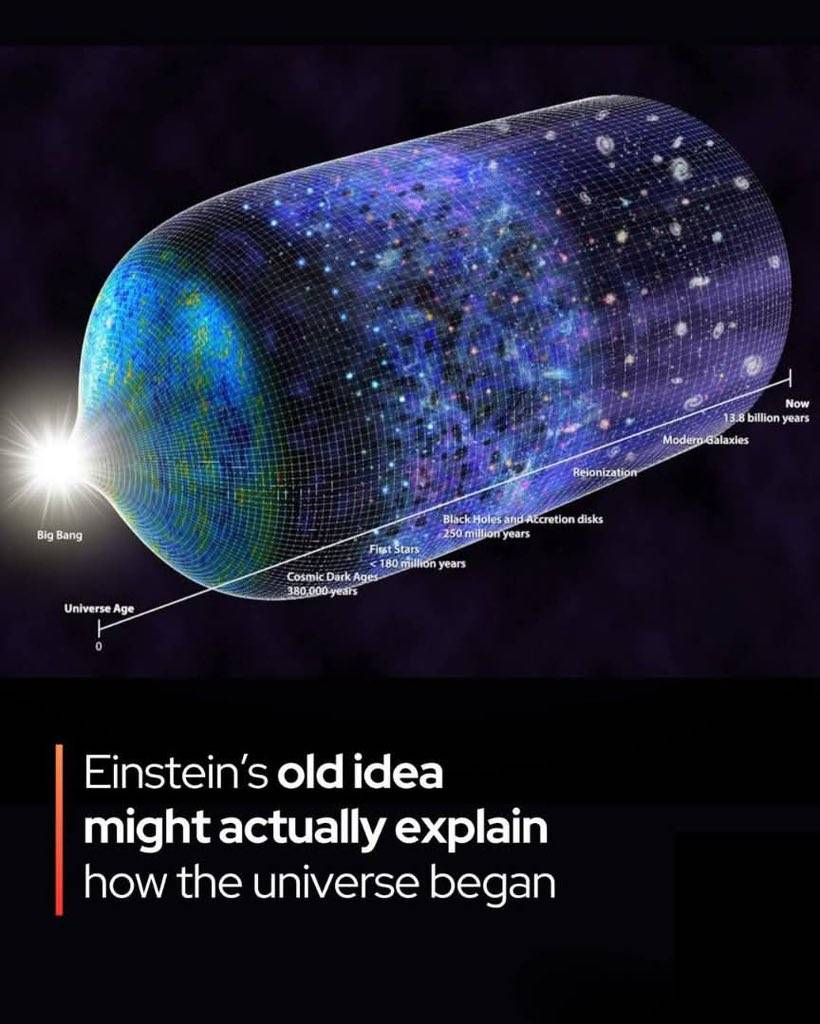
A century-old insight from Albert Einstein may be shaking the very foundations of how we understand the universe’s birth. In a daring new model, scientists from Spain and Italy suggest that the rapid expansion of the cosmos after the Big Bang wasn’t driven by the mysterious “inflation” theory we’ve long accepted — but by gravitational waves, the ripples in spacetime Einstein first predicted in 1916.
Unlike inflation, which depends on an unproven “inflaton” field, this revolutionary idea builds entirely on known physics — blending Einstein’s general relativity with quantum mechanics. According to the team, gravitational waves could have sculpted the infant universe itself, stretching and shaping spacetime in a way that naturally led to the formation of galaxies and cosmic structure. In this view, gravity wasn’t just holding the universe together — it was driving its earliest, most explosive expansion.
Grounded in the mathematical concept of De Sitter space, the model provides a simpler, testable alternative to inflation — one that doesn’t rely on exotic or hypothetical forces. Simulations suggest that gravity and quantum effects alone might explain how the universe evolved in those first, crucial moments. It doesn’t replace the Big Bang, but it could rewrite what happened right after — a profound shift that may finally bring us closer to uniting the great pillars of modern physics into one elegant theory of everything.
0 likes · 0 comments · 0 shares