Post by Mohammad Shamsuddeen Musa (@shamsumaiyaki)
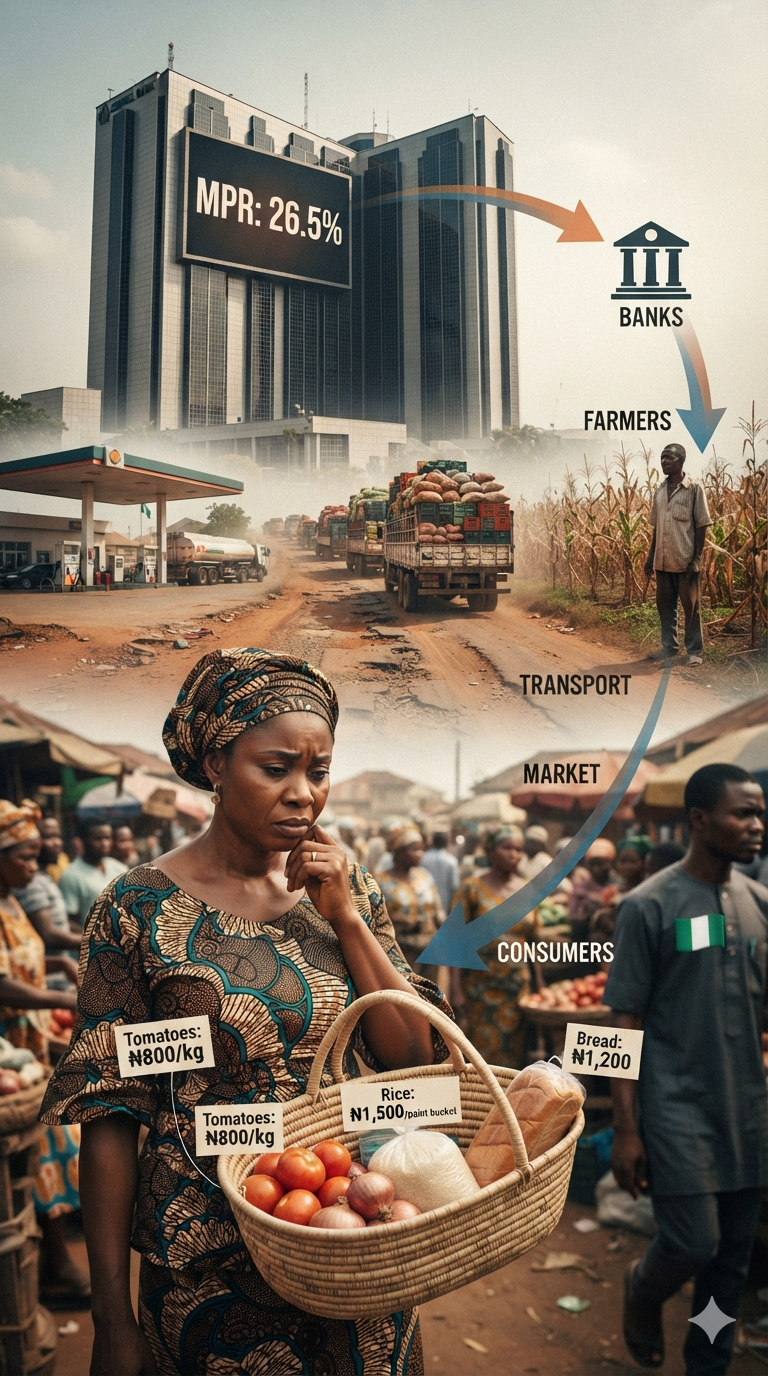
Will Food Prices Go Down After the CBN Kept Interest Rates at 26.5%?
When the Central Bank of Nigeria (CBN) announced that it would keep the Monetary Policy Rate (MPR) at 26.5%, many Nigerians immediately asked a simple question:
"Does this mean food prices will finally come down?"
The short answer is not immediately.
While the CBN's decision is aimed at controlling inflation, food prices depend on many factors beyond interest rates. To understand why, we first need to understand what interest rates actually do and how they affect the economy.
What Is the Monetary Policy Rate (MPR)?
The Monetary Policy Rate (MPR) is the benchmark interest rate set by the CBN. It influences the rates at which commercial banks lend money to businesses and individuals.
Think of it as the "price of borrowing money."
A higher MPR makes loans more expensive.
A lower MPR makes loans cheaper.
When the MPR remains high - as it is at 26.5% - banks generally charge higher interest on loans.
Why Did the CBN Keep Interest Rates High?
Nigeria has been experiencing persistent inflation, where the prices of goods and services continue to rise.
The CBN's main objective is to reduce inflation.
Its reasoning is straightforward:
- If borrowing becomes expensive,
- Fewer people and businesses take loans.
- When people spend less, demand for goods slows.
- Slower demand reduces pressure on prices.
- Eventually, inflation should ease.
This strategy is used by central banks around the world. However, the process takes time.
Why Food Prices May Not Fall Immediately...
Many people assume that controlling inflation automatically means food prices will start dropping.
Unfortunately, that's not how inflation works.
Food prices are influenced by several major factors.
1. High Transportation Costs:
Moving food from farms to markets requires fuel, vehicles, and good roads.
When fuel prices rise:
- Transportation becomes more expensive,
- Traders pay more,
- Consumers ultimately bear the cost.
Even if interest rates stay high, expensive transport can keep food prices elevated.
2. Farming Challenges.
Farmers face numerous obstacles, including:
- Insecurity in farming communities,
- Flooding,
- Drought,
- Pests and crop diseases,
- Limited access to fertiliser,
- High costs of farming equipment.
If farmers produce less food, supply decreases.
Lower supply with strong demand usually leads to higher prices.
Interest rates alone cannot solve these problems.
3. Exchange Rate Pressures.
Nigeria imports:
- Fertiliser,
- Agricultural chemicals,
- Machinery,
- Food processing equipment,
- Some food items.
If the naira weakens against foreign currencies, imported goods become more expensive.
These additional costs are often passed on to consumers.
4. Cost of Doing Business.
Food businesses also pay for:
- Electricity,
- Diesel,
- Packaging,
- Wages,
- Rent,
- Storage,
- Distribution.
If these costs continue rising, food prices are unlikely to fall significantly.
Can High Interest Rates Actually Increase Food Prices?
Surprisingly, YES.
Many farmers and food processors rely on bank loans.
When interest rates are high:
- Borrowing becomes more expensive,
- Businesses invest less,
- Production slows,
- Expansion is delayed.
Some producers recover these higher financing costs by increasing prices. This is one reason why reducing inflation is rarely straightforward.
Then Why Keep Interest Rates High?
Although high rates have disadvantages, the CBN believes the long-term benefits outweigh the short-term pain.
Without action:
- Inflation could worsen,
- The naira could weaken further,
- Purchasing power could decline,
- Savings could lose value more quickly.
Maintaining higher interest rates is intended to stabilise the economy before conditions improve.
When Could Nigerians See Lower Food Prices?
Food prices may begin to stabilise if several positive developments occur together:
- Inflation continues to slow,
- Harvests improve,
- Insecurity affecting farmers decreases,
- Transport costs reduce,
- The naira becomes more stable,
- The supply of food increases.
Notice that interest rates are only one part of a much larger picture.
What Does This Mean for Ordinary Nigerians?
For consumers:
- Food prices may remain high for some time.
- Budgeting carefully remains important.
- Price reductions, if they come, are likely to be gradual rather than sudden.
For businesses:
- Borrowing remains expensive.
- Expansion plans may be slow.
- Managing costs becomes increasingly important.
For savers:
Higher interest rates may lead some banks to offer better returns on savings and fixed deposits, although this varies by institution.
A Simple Analogy.
Imagine Nigeria's economy as a speeding car heading towards a dangerous bend. Inflation is the excessive speed. The CBN raises interest rates like pressing the brakes.
Pressing the brakes slows the car, but it does not instantly repair potholes, remove traffic, or improve the road.
0 likes · 0 comments · 0 shares