Post by Jeph Anne (@jephanne24)
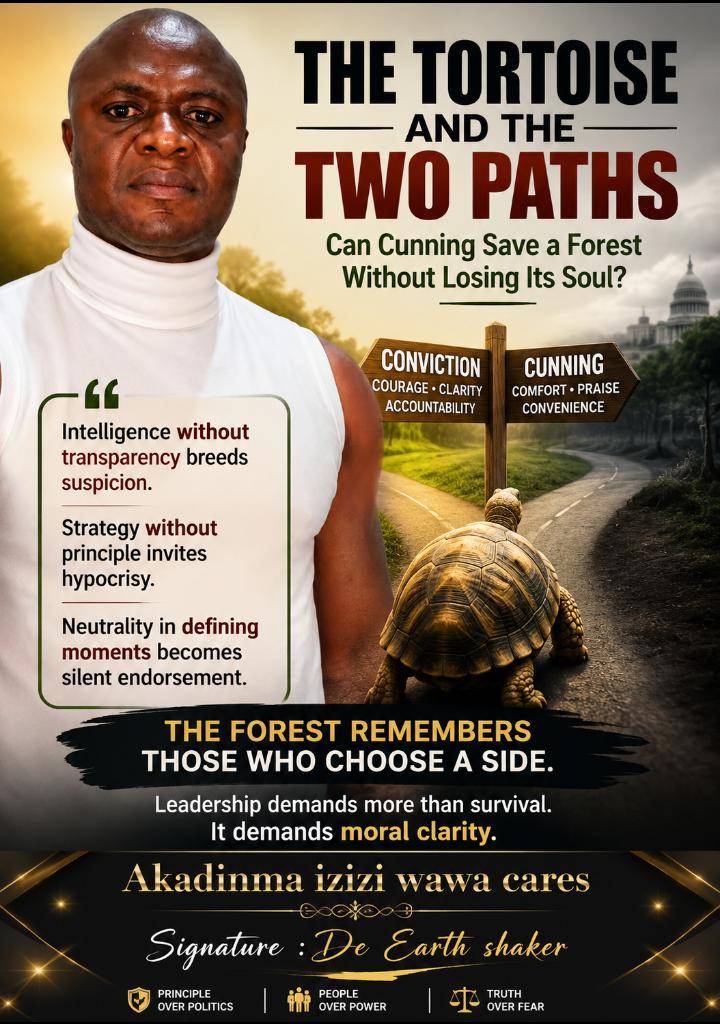
The Tortoise and the Two Paths: Can Cunning Save a Forest Without Losing Its Soul?
In African folklore, the tortoise is admired for intelligence, patience, and survival. But the same tortoise is also feared because it often survives by speaking different words to different animals. It smiles at the lion, comforts the antelope, and assures the monkey that it stands with everyone. Eventually, the forest begins to ask a difficult question: Is the tortoise wise, or simply unwilling to choose a side?
Politics often resembles that forest.
A governor may argue that praising the president is necessary to attract roads, investments, security cooperation, or federal projects for his state. That is the language of pragmatism. His supporters call it strategic leadership. His critics call it compromise.
The tortoise would probably approve.
Yet history teaches another lesson. The greatest political movements are rarely built on clever calculations alone. They are sustained by conviction, sacrifice, and clarity of purpose. When followers believe they are engaged in a struggle for change, they expect their leaders to speak with one voice. Once influential figures begin sending mixed signals, uncertainty spreads through the ranks.
The tortoise may keep himself safe, but the other animals no longer know where he truly stands.
This is where the real debate begins. Can a leader simultaneously praise the government he is expected to challenge while convincing supporters that he still represents an alternative? Some argue yes. They say governance requires maturity, diplomacy, and cooperation beyond party lines. Others insist that excessive praise weakens the opposition and leaves citizens confused about what the opposition actually stands for.
Neither argument should be dismissed lightly.
The danger of excessive pragmatism is that it gradually becomes indistinguishable from political convenience. A leader who constantly explains every compromise as "strategy" risks losing the moral authority that first inspired public confidence. Supporters begin asking whether the strategy serves the people or simply protects political interests.
The tortoise always has an explanation.
Another lesson from folklore is that cunning produces short-term victories but not always lasting trust. Once the animals discover that the tortoise tells each of them a different story, they stop believing him—even when he finally speaks the truth.
Politics is no different.
Every opposition movement depends not only on elections but also on credibility. If its most prominent figures appear comfortable on both sides of the political divide, citizens may struggle to distinguish conviction from convenience. Volunteer enthusiasm weakens. Public confidence declines. The movement risks becoming less a united force and more a collection of individuals pursuing separate calculations.
Yet fairness demands another perspective. Governors have constitutional responsibilities to their states. They may believe that maintaining cordial relations with the federal government benefits their citizens regardless of party differences. Voters can reasonably debate whether that approach reflects wise governance or excessive accommodation.
Ultimately, democracy requires citizens—not politicians alone—to judge where the balance lies.
The tortoise theory reminds us that intelligence without transparency can breed suspicion. Strategy without principle can invite accusations of hypocrisy. And neutrality during defining political moments may be interpreted differently by different audiences.
The real question is therefore larger than any individual politician:
Can a movement built on the promise of change remain united if its leading figures increasingly choose the cautious path of the tortoise rather than the courageous path of unmistakable conviction?
That question belongs not to one governor, one party, or one election. It belongs to every democracy where citizens must decide whether political survival is enough—or whether leadership also demands moral clarity.
0 likes · 0 comments · 0 shares