Post by Udeze Nestor (@Nesmoore1)
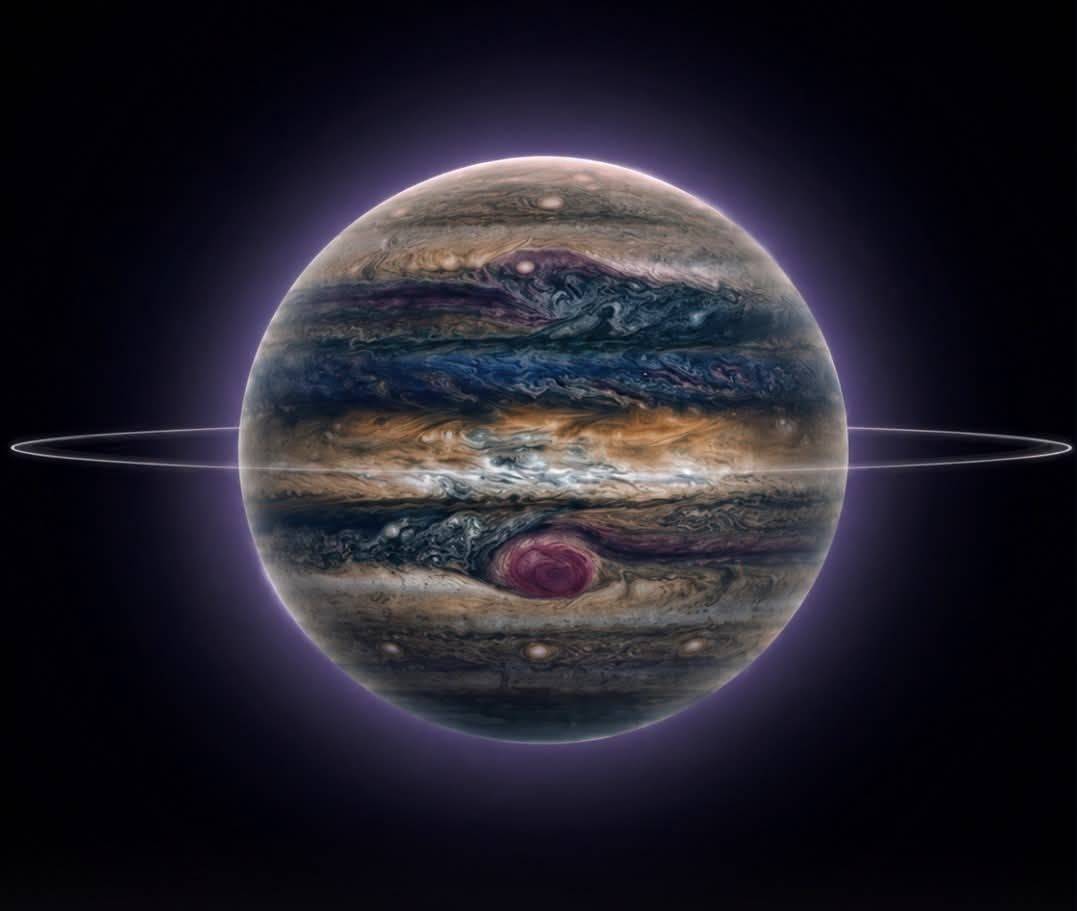
NASA’s James Webb Space Telescope has shown Jupiter in a way human eyes could never see.
In infrared light, the largest planet in our solar system looks almost unreal: glowing auroras near its poles, bright high-altitude clouds, the famous Great Red Spot shining pale because of reflected sunlight, and even Jupiter’s faint ring system appearing in the darkness around it.
Webb sits nearly 1 million miles from Earth near the Sun-Earth L2 point, where it studies the universe in infrared wavelengths. That allows it to see details hidden from ordinary visible-light telescopes, from storms on nearby planets to galaxies formed in the early universe.
NASA’s Webb observations of Jupiter have already revealed more than just a beautiful picture. Scientists have used them to study the planet’s powerful auroras and even identify a high-speed jet stream above Jupiter’s equator, moving at about 320 miles per hour.
That is what makes this image so powerful.
It is not just a portrait of a planet.
It is a reminder that even Jupiter, a world we have studied for centuries, still has secrets waiting in its clouds, rings, storms, and magnetic storms.
The more powerful our telescopes become, the more the universe reminds us how much we still have not seen.
0 likes · 0 comments · 0 shares