Post by Jeph Anne (@jephanne24)
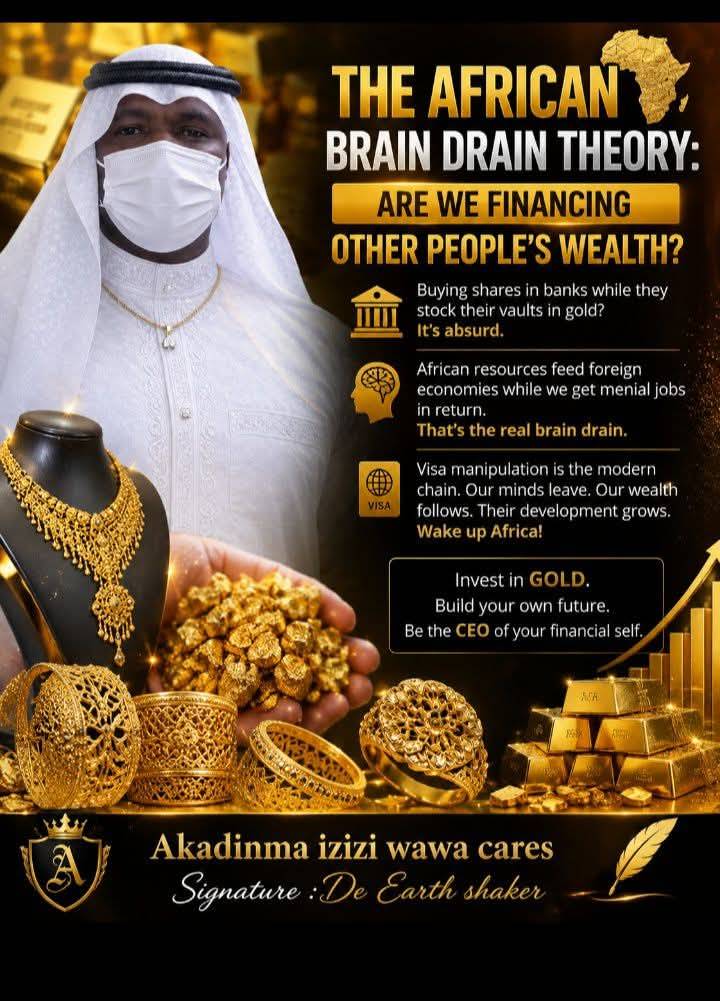
The African Brain Drain Theory: Are We Financing Other People's Wealth?
What if the greatest export from Africa is not oil, gold, diamonds, or cocoa—but African intelligence, labour, and capital?
Think about it.
Many people invest their savings by buying shares in banks, hoping for modest annual returns. Yet those same financial institutions often invest in assets, businesses, and commodities that generate far greater long-term value. The ordinary investor receives a relatively small return, while the institution builds lasting wealth.
Now extend that idea to Africa.
For centuries, Africa has supplied the world with minerals, precious metals, energy resources, agricultural products, and skilled professionals. Gold, cobalt, lithium, diamonds, oil, rare earth minerals, doctors, engineers, scientists, entrepreneurs, and innovators continue to leave the continent in search of better opportunities abroad.
This is what I call the African Brain Drain Theory.
It is the argument that Africa repeatedly exports its most valuable resources—both natural and human—while importing dependency. Wealth leaves. Finished products return. Talent leaves. Remittances return. Raw materials leave. Expensive manufactured goods return.
The result is a cycle that many Africans question.
Some critics describe restrictive immigration systems and selective skilled-worker recruitment as creating incentives that attract highly educated Africans to wealthier countries. Others argue these pathways provide life-changing opportunities for individuals while also benefiting destination countries. Both perspectives deserve careful discussion.
Imagine a village selling its fertile farmland, then paying rent to buy food grown on that same land.
Would that be development?
Or dependence?
Gold has historically been viewed as a store of value because it is scarce and cannot be created at will. Many investors choose to own physical gold or gold-related investments as part of a diversified portfolio. Others prefer bank shares because they offer dividends, liquidity, and exposure to the financial sector. Each approach carries different risks and potential rewards, and neither is universally superior.
The larger question is not simply where Africans invest their money.
It is where Africa builds its wealth.
Should African nations continue exporting raw materials with limited local processing?
Should African universities continue educating professionals who leave because opportunities elsewhere are more attractive?
Should African economies remain primarily suppliers while others dominate manufacturing, finance, and technology?
These questions do not have simple answers, but they deserve public debate.
A continent rich in resources should also strive to be rich in value creation, innovation, industrial capacity, and financial ownership.
Real economic transformation is not achieved merely by extracting wealth.
It is achieved by retaining more of the value created from that wealth.
Perhaps the future of Africa lies not only in discovering more resources, but in building stronger institutions, expanding local industries, encouraging entrepreneurship, creating attractive opportunities for skilled professionals, and investing in enterprises that keep more value within African economies.
The debate is open.
Is Africa participating fairly in the global economy?
Or is it still exporting tomorrow's prosperity while importing today's survival?
0 likes · 0 comments · 0 shares