Post by ThankGod Ochai (@ThankGod_Ochai)
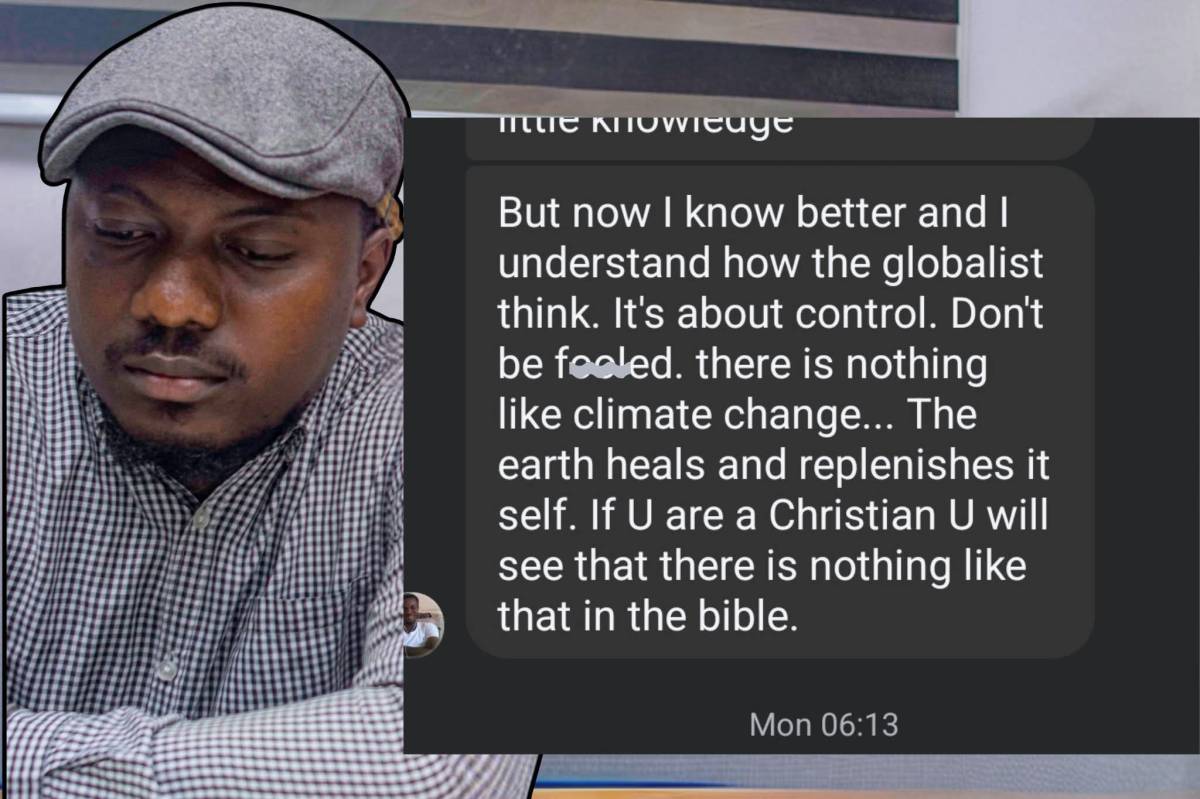
Someone I know from undergraduate days sent me this in through DM, and we had an interesting intellectual conversation.
Part of our discussion was the message in the attached photo, which argues that climate change isn't real and is simply a tool for control.
The conversation became even more interesting when Mr. Olamide Martins shared some thoughtful insights that challenged me to think more deeply. Some of those reflections are captured in my response below.
My Response
The Earth's climate has always changed naturally. That's not a dispute. What scientists have documented is that the current rate of warming is occurring much faster than many natural climate changes in recent geological history and is being driven largely by human activities such as burning fossil fuels and deforestation.
There are indeed different schools of thought on climate change, and while they often disagree, many are driven by genuine concerns. However, one thing is difficult to ignore: the impacts we are already seeing.
In Nigeria, we are experiencing more frequent and intense flooding in many southern states, increasing desertification across parts of the north, rising temperatures, and changing rainfall patterns that affect agriculture and livelihoods.
Consider Lake Chad. Once one of Africa's largest freshwater lakes, it has lost about 90% of its historical surface area since the 1960s due to a combination of prolonged drought, reduced river inflows, and increased water use. Whatever the relative contribution of each factor, its decline has affected millions of people across the region.
I think the claim that climate change is merely a tool for global control speaks more to the politics surrounding climate change than to the science itself. We should distinguish between the political economy of climate policy and the scientific evidence for climate change.
I understand the concern that powerful economies and political interests can shape climate narratives to serve their interests. That's a valid discussion. At the same time, countries around the world are investing heavily in adaptation and mitigation technologies, including carbon capture, renewable energy, net-zero strategies, and research into geoengineering. Whether we agree with every policy or not, these investments reflect the seriousness with which many governments and scientific institutions view climate risks.
We should also ask ourselves: could the thousands of scientists who contribute to the IPCC assessments all be fundamentally wrong? Could experts and negotiators from almost every country participating in the UN climate process all be wrong? Are organizations such as the World Meteorological Organization and national meteorological agencies around the world fabricating evidence? I don't think that's a reasonable conclusion.
As for Christianity, I don't think believing in climate change conflicts with the Bible. The Bible isn't a science textbook, so it doesn't discuss modern scientific terms like climate change, electricity, or the internet.
What it does teach is that humans are stewards of God's creation (Genesis 2:15) and should care for it. Looking after forests, water, clean air, and the people most affected by floods, droughts, and extreme weather aligns with that responsibility.
Finally, while it is true that the Earth has an incredible capacity to recover, recovery cannot keep pace with continuous deforestation, pollution, habitat destruction, biodiversity loss, and rising greenhouse gas emissions. As many of the Earth's natural systems develop over millions even billions of years. Damaging them can happen far more quickly than restoring them.
Rather than debating whether climate change exists, I think our conversation should focus on understanding the evidence, separating the science from the politics, and discussing how Nigeria can better adapt to the realities we are already experiencing.
I'd also love to hear your perspectives. Please share your thoughts.
0 likes · 0 comments · 0 shares