Post by Udeze Nestor (@Nesmoore1)
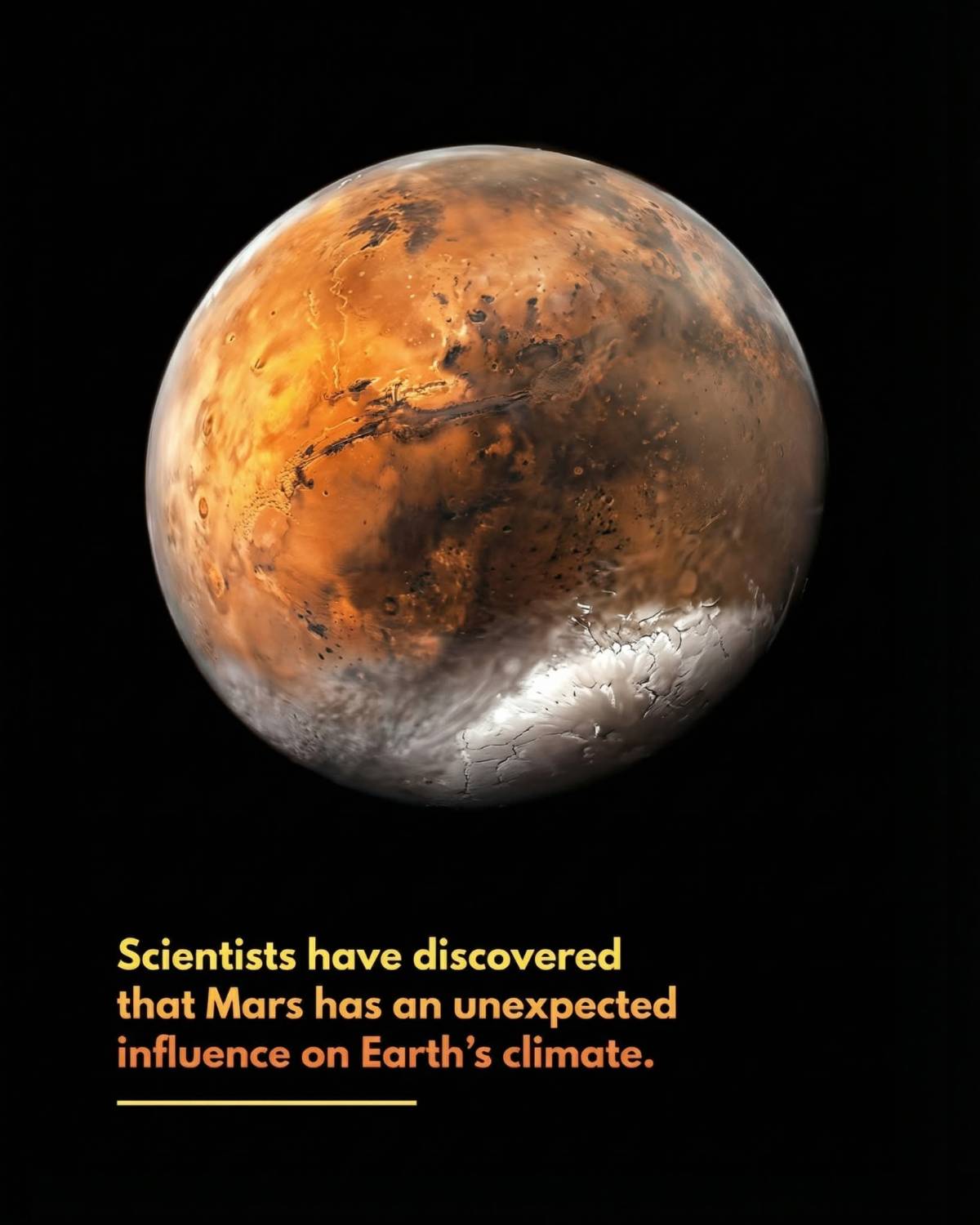
Scientists just discovered that Earth's climate cycle is shaped by Mars.
Mars may be only a fraction of Earth's size, but its gravitational pull is a vital architect of our planet's long-term climate rhythms.
A new study reveals that the Red Planet is essential to Earth’s Milankovitch cycles—the slow orbital variations that dictate the arrival of ice ages and warm interglacials over millions of years. By simulating variations in Martian mass, researchers discovered that Earth’s seasons and axial stability are deeply entangled with its neighbor, proving that our climate is a product of the entire inner Solar System’s gravitational dance rather than an isolated phenomenon.
The research highlights that the 2.4-million-year 'grand cycle' in Earth's climate only exists because Mars provides the necessary gravitational resonance to lock Earth into its current rhythm. Furthermore, the simulations show that if Mars were more massive, the 100,000-year cycles that pace modern ice ages would be significantly disrupted. These insights provide a new blueprint for assessing the habitability of distant exoplanets, helping scientists identify alien worlds where the presence of a specific planetary neighbor might be the key to maintaining a stable environment conducive to life over geological timescales.
source: Kane, S. R., et al. (2025). The Dependence of Earth Milankovitch Cycles on Martian Mass. Publications of the Astronomical Society of the Pacific.
0 likes · 0 comments · 0 shares