Post by Udeze Nestor (@Nesmoore1)
A Cosmic Question Mark, 400 Million Light-Years Away
The universe just dropped the ultimate mic drop.
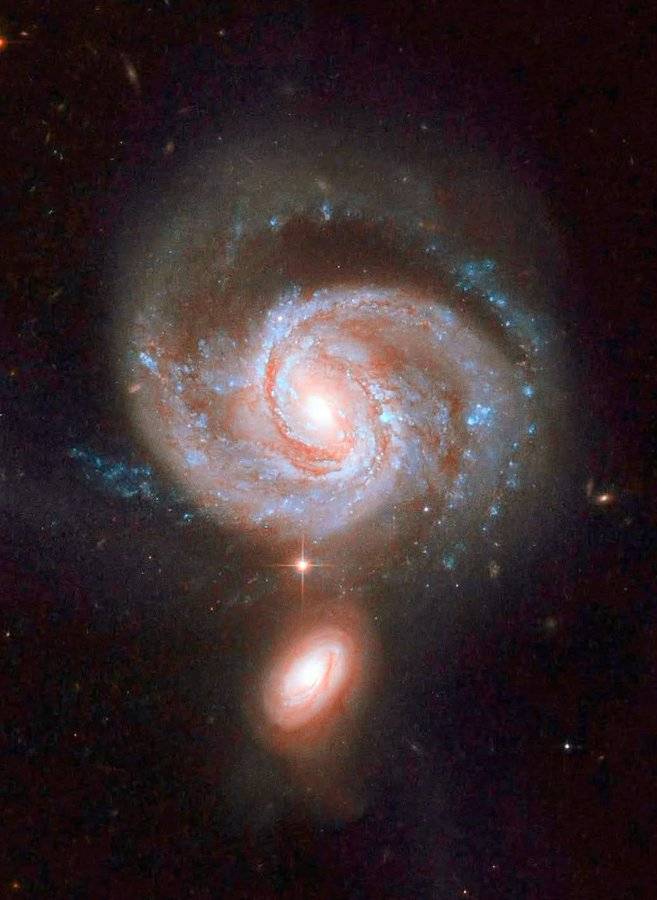
Captured by the Hubble Space Telescope, this breathtaking image shows NGC 7674 (also known as Markarian 533) — a majestic barred spiral galaxy — locked in a dramatic gravitational tango with its smaller companion, NGC 7674A. Together, they form a luminous question mark suspended in the void, as if the cosmos itself is asking us: What happens when galaxies collide?
This dynamic pair belongs to the ultra-dense Hickson Compact Group 96 and earned its spot in Halton Arp’s legendary Atlas of Peculiar Galaxies as Arp 182. But the real story lies beneath the beauty: raw, violent physics playing out on a galactic scale.
The Cosmic Airbag: Shock Waves
When the gas clouds of these two galaxies slam into each other at hundreds of kilometers per second, the impact is cataclysmic. The gases compress so violently it’s like two cosmic airbags deploying at once. This sudden squeeze triggers an explosive burst of star formation — brilliant neon-blue knots lighting up along the spiral arms. These are starburst regions, where billions of hot, young stars ignite in a cosmic fireworks show visible across hundreds of millions of light-years.
The Quicksand Effect: Dynamical Friction
Meanwhile, the smaller galaxy is doomed. It’s plunging through the gravitational “soup” of its larger neighbor. Every orbit stirs up stars and dark matter behind it, creating an invisible drag that slowly bleeds away its momentum — like trying to run through honey. Inevitably, it’s spiraling inward for a final, inevitable merger.
Cosmic Fact Sheet
Location**: Pegasus constellation
Distance**: 400 million light-years
Size**: The main galaxy stretches over 110,000 light-years across — slightly larger than our Milky Way
The Ultimate Secret: Deep in its core lurks something extraordinary — a **Seyfert Type 2 active galactic nucleus powered by not one, but two supermassive black holes orbiting each other at a distance of just one light-year. They’re among the closest binary black hole candidates ever found.
This isn’t just a pretty picture. It’s a live demonstration of how galaxies grow, merge, and evolve — the same processes that shaped our own Milky Way billions of years ago.
Next time you look up at the night sky, remember: somewhere out there, the universe is still writing its story… and right now, it’s asking a very big question
0 likes · 0 comments · 0 shares