Post by Ceejay Oji (@CeejayOji)
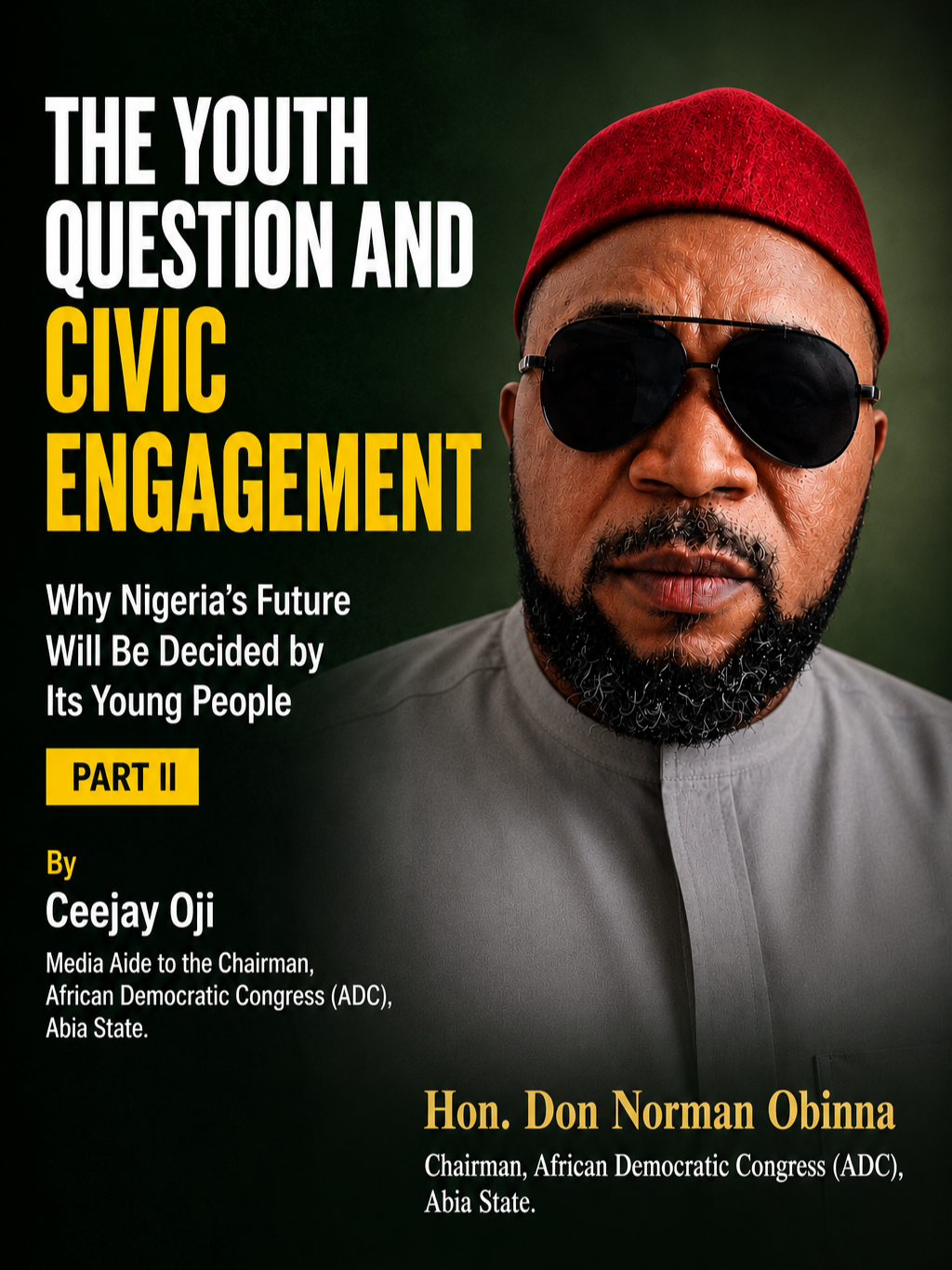
THE YOUTH QUESTION AND CIVIC ENGAGEMENT: WHY NIGERIA'S FUTURE WILL BE DECIDED BY ITS YOUNG PEOPLE (PART II)
By: Ceejay Oji
Media Aide to The Chairman African Democratic Congress (ADC), Abia State.
In the first part of this essay, I explored the historic role of young Nigerians in the struggle for independence, democratic governance, and national development. That discussion provided an important backdrop to a more pressing question: having inherited the gains of previous generations, what responsibility rests on the shoulders of Nigerian youths today?
For readers joining the conversation at this point, Part 1 can be accessed here:
https://www.facebook.com/share/p/1M9v7oTjWW/
The challenge confronting today's generation is markedly different from that faced by those who fought colonialism or resisted military rule.
While the battles have changed, the need for civic engagement has not.
Today's young Nigerians are navigating a country burdened by economic uncertainty, unemployment, insecurity, and growing distrust in public institutions.
At the same time, they are the most connected, informed, and technologically empowered generation in the nation's history.
Never before have young people possessed such capacity to influence public opinion, mobilise support for causes, and shape national conversations.
The real question, therefore, is whether this influence will be converted into sustained civic action.
The success of the Not Too Young To Run movement remains a powerful reminder of what organised engagement can achieve. Through advocacy, coalition building, and democratic pressure, young Nigerians secured constitutional reforms that expanded political opportunities for a new generation. It was a victory not merely for youth inclusion, but for the principle that citizens can influence the institutions that govern them.
The #EndSARS movement delivered a similar lesson. Whatever one's perspective on its evolution, it represented one of the most significant youth-led civic mobilisations in contemporary Nigeria. It demonstrated the ability of young Nigerians to organise across ethnic, religious, and regional divides in pursuit of a common objective:
the demand for accountability.
Yet one lesson stands above all others. Civic engagement cannot be episodic. It cannot begin and end with protests, hashtags, or election cycles.
Democracy requires consistency.
It requires participation in political parties, community organisations, policy conversations, advocacy groups, and electoral processes. It demands citizens who are willing not only to identify problems but also to engage the institutions through which solutions are achieved.
The 2023 general elections reflected both the promise and the challenge of youth participation. Across the country, millions of young Nigerians became politically active, many for the first time. They registered to vote, volunteered for campaigns, engaged in public debates, and followed electoral developments with unprecedented interest.
That enthusiasm was encouraging. But the health of a democracy is measured not by engagement during elections alone, but by what happens after the votes have been counted.
As Professor PLO Lumumba has repeatedly argued, Africa's greatest resource is neither oil nor minerals but its people. In Nigeria's case, that resource is overwhelmingly youthful.
From technology and entrepreneurship to sports, entertainment, and innovation, Nigerian youths continue to demonstrate extraordinary talent and resilience. The challenge before them is to bring that same energy into the civic and political spaces where the future of the nation is shaped.
Nelson Mandela famously observed that "the youth of today are the leaders of tomorrow." Yet leadership is not inherited. It is cultivated through participation, responsibility, and service.
Nigeria's future will not be decided solely by those who occupy public office. It will also be determined by those who choose to engage, organise, advocate, vote, and contribute to the life of their communities and country.
The youth question, therefore, is not simply about age. It is about citizenship. It is about whether a generation blessed with unprecedented opportunities for engagement will embrace its responsibility to shape the future.
History has opened a door. Whether Nigeria walks through it depends, to a large extent, on the choices its young people make today.
What role do you think young Nigerians should play in shaping the country's future? Share your thoughts in the comments.
0 likes · 0 comments · 1 shares