Post by Akinniyi Akinbamiro (@akinniyiakinbamiro)
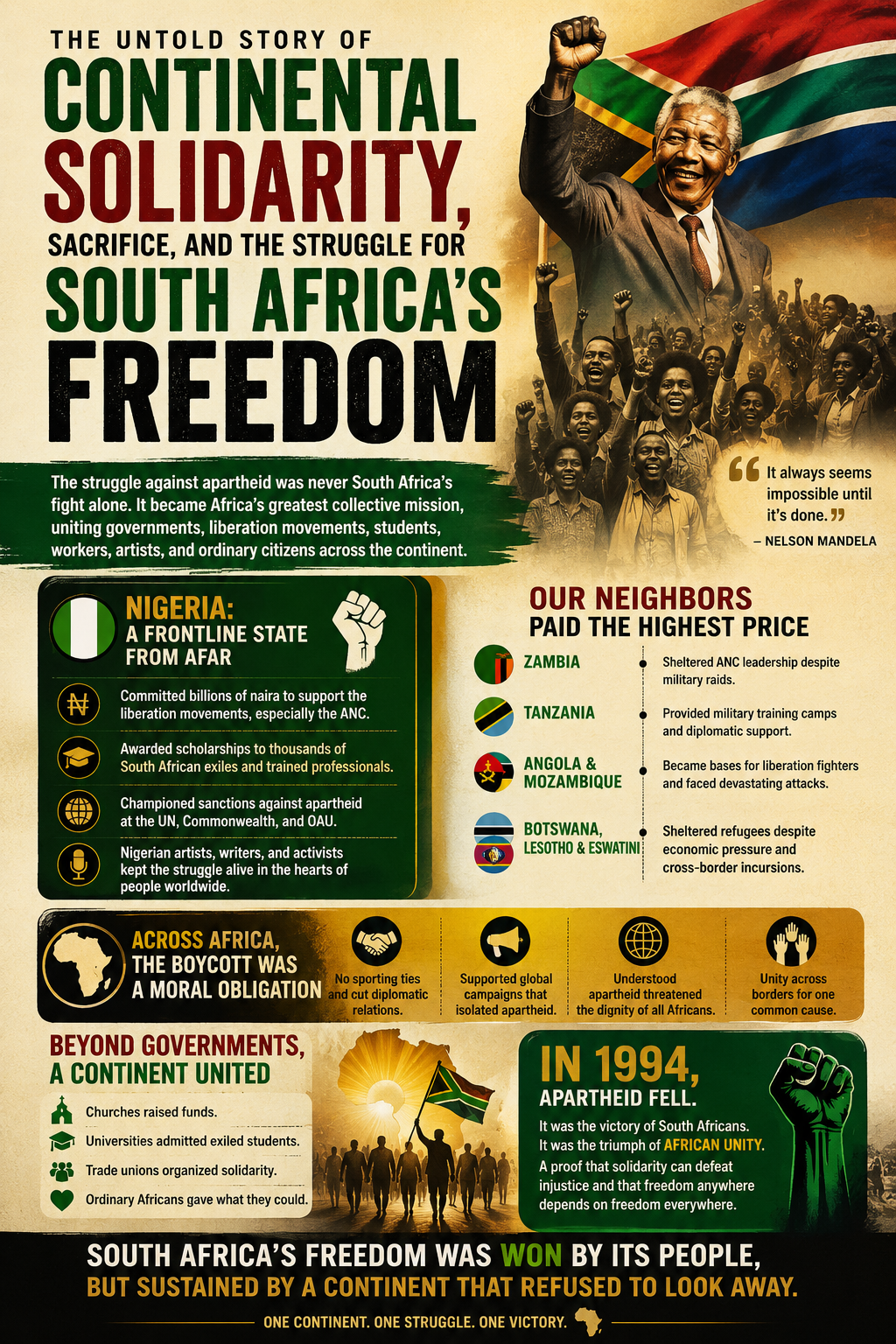
The untold story of continental solidarity, sacrifice, and the struggle for South Africa's freedom.
The struggle against apartheid was never South Africa's fight alone. It became Africa's greatest collective mission, uniting governments, liberation movements, students, workers, artists, and ordinary citizens across the continent. While South Africans bravely resisted racial oppression from within, countries like Nigeria, Zambia, Tanzania, Angola, Mozambique, Botswana, Zimbabwe, and many others carried enormous political, economic, and military burdens to ensure apartheid would eventually fall.
Nigeria emerged as one of the strongest voices against apartheid. Often called the "Frontline State from afar," Nigeria committed billions of naira over several decades to support South Africa's liberation movements, particularly the African National Congress (ANC). The country established the Southern Africa Relief Fund in 1976, encouraging citizens, workers, and students to donate voluntarily. Nigeria also awarded scholarships to thousands of South African exiles, trained professionals, and consistently used its influence in the United Nations, the Commonwealth, and the Organization of African Unity (OAU) to demand sanctions against the apartheid regime. Nigerian musicians, writers, and activists also amplified the cause, ensuring it remained in global consciousness.
The countries bordering South Africa paid an even heavier price. Zambia hosted the ANC leadership despite repeated military raids by the apartheid government. Tanzania provided military training camps and diplomatic support. Angola and Mozambique became bases for liberation fighters after gaining independence from Portuguese rule, even as they faced devastating attacks and destabilization by South African forces. Botswana, Lesotho, and Eswatini sheltered refugees despite facing economic pressure and cross-border incursions.
Across Africa, the boycott of apartheid became a moral obligation. African nations refused sporting ties, cut diplomatic relations, and supported international campaigns that isolated South Africa economically and politically. The continent understood that apartheid was not merely a South African issue—it represented the unfinished business of colonialism and threatened the dignity of all Africans.
The support extended beyond governments. Churches raised funds, universities admitted exiled students, trade unions organized solidarity campaigns, and ordinary Africans contributed whatever they could. This spirit of Pan-Africanism demonstrated that freedom anywhere in Africa depended on freedom everywhere in Africa.
When apartheid finally collapsed in 1994 and South Africa held its first democratic elections, it marked not only the victory of Nelson Mandela and the South African people but also a triumph for African unity. The sacrifices made by Nigeria and many other African nations proved that solidarity can overcome even the most deeply entrenched systems of injustice.
South Africa's freedom was won by its people, but it was sustained by a continent that refused to look away. The history of apartheid is therefore not only a South African story—it is one of Africa's greatest examples of collective courage, shared sacrifice, and unwavering belief that justice would ultimately prevail.
0 likes · 0 comments · 0 shares