Post by Udeze Nestor (@Nesmoore1)
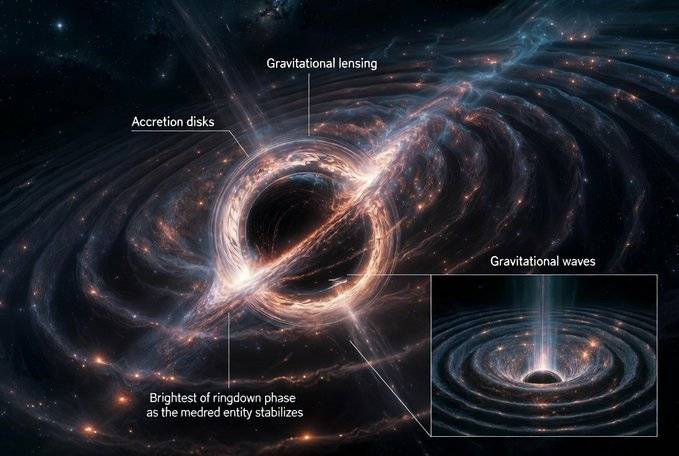
Astronomers have, for the first time, probed the event horizon region of a black hole using gravitational waves. Analyzing the loudest detected signal so far — GW250114 from a binary black hole merger — researchers from OzGrav/ANU identified a previously under-explored "direct wave" component emitted right at the moment of collision. This allowed them to measure key properties of the newly formed black hole, such as its rotation frequency and surface gravity, very close to the horizon. The breakthrough, published in Nature, opens a new observational window into extreme gravity where general relativity and quantum effects meet, and paves the way for future tests of fundamental physics.
0 likes · 0 comments · 0 shares