Post by Prince Atanda (@princewriter01)
Why It Sucks to Be Born an Average Poor Hausa in the North.
The day you are born, you are born into a family of 15. Your mother is the 4th wife. The first voice you hear is the call to prayer. You are cut. The naming ceremony comes shortly.
You are born in a crowded place where noise feels like music and the ground feels like the edge of the world. Your mother goes out to beg for daily food. You never know your father's job. Life is chaotic, and all you know is your mother and siblings.
But there is hope.
At five years old, you see your mother pregnant again. She kisses your eyes.
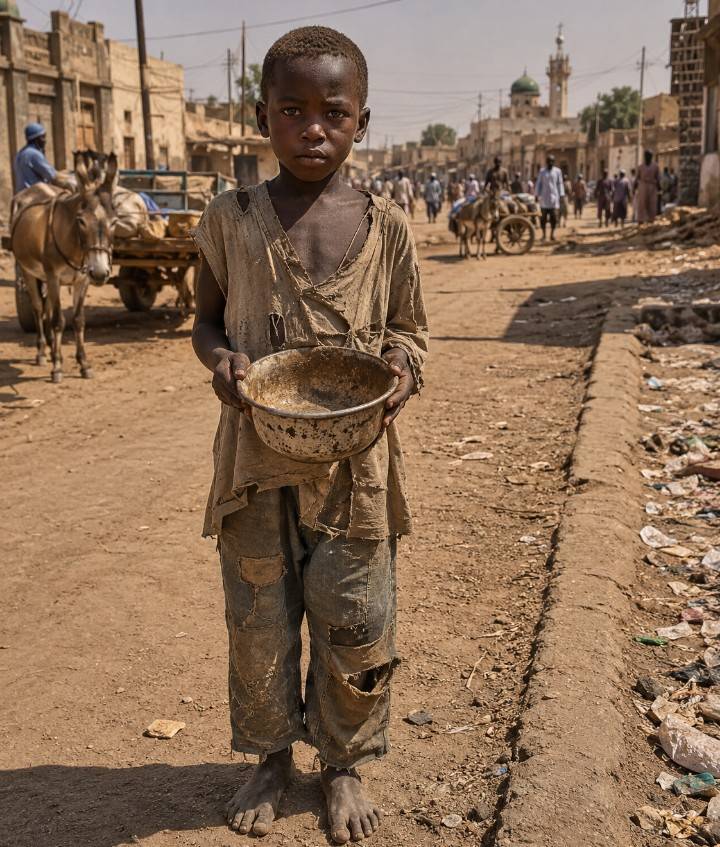
Your father puts you on an old bike and takes you to Almajiri school. There are many children like you. You lose count. You begin learning from a small text board — alif to ba to ta. He brings food and clothes at first, but after a year, you never see him again.
You think you will never see your mother or your siblings again.
Your mallam grows a bow and sends you out with your age mates to beg. You are old enough now. You stand in the scorching sun, begging. You do not see this as suffering. It is survival. That is what everyone does. Your dream job is to be a mallam.
One day, a sheikh visits your mosque on Sunday. He gives a sermon. It is breathtaking. You think, "I will be like him."
You take your Arabic lessons seriously and become a Quranic reciter, but the real struggle is still feeding yourself each morning. You become street-smart, surviving on whatever you can earn — sometimes ₦500, sometimes ₦1,000.
One day on the streets, you see a video of a Hafiz reciting the Quran on a shop screen. They say he is from your land. He won a competition and was rewarded with a car and money. You look at it and think: if knowledge of God can bring this kind of life, then you must learn harder.
Your imam gives you a powerful sermon against the infidels in your environment. You know about 4 churches.
After the sermon, he calls you and your friend. He gives you 50,000 naira each to plant bombs in the four churches. You never hesitate. Allah commands it. You spend days training. You successfully eliminate them.
The last church, your 4 friends decide to martyr themselves. Because they will enter paradise. You are a coward. You couldn't. You and Ahmad.
Ahmad disappeared that day.
The 50,000 naira was gold to you. But the church bomb and the victims hurt you. Every sleep at night feels like a trap in the noise of the infidels you killed.
One day, Ahmad returns. He looks healthier and different. He tells you about a world beyond yours — the South. You decide to leave and discover it yourself.
For the first time, you see city life. You wonder why others seem to have opportunities you never had. You question what you were taught and ask yourself: maybe they are not weak; maybe they simply value peace.
You remember that Allah is the God of everyone. You begin working hard.
While pushing a wheelbarrow, you hear people talking about the country and its leaders. You start questioning leadership. Through conversations and learning, you realize Nigeria is made up of many tribes and identities.
You understand why Ahmad corrected you — he is Fulani. You realize faith connects people, but identity is also complex.
When you return North during Ramadan, you cannot find your parents. The place you knew has changed. You are confused. You were taught Muslims are brothers, but reality feels more complicated.
You see contest posters full of promises. You wonder, "So we have leaders?" You grab your phone and see that many people contest with promises but give nothing after they enter. You try to find out what happened to your family. They said Fulani attacked their compound. They are dead. You say, "My parents are not infidels." You know that could be the only reason they were killed. You cry and cry.
You start feeling the pain of the families that lost their loved ones in the church you bombed. And your friends who did not survive the explosion, who martyred themselves.
But Allah is the all-knowing.
You start wondering: if people in the South can live an average life, then what does that make you? You begin questioning everything around you. You look at leadership, identity, and belonging.
You search through history and the stories you can find. You discover different views about land, origins, and who belongs where. The more you learn, the more questions you have.
You ask yourself: How did you end up here? Why do religion, knowledge, and identity feel like they are pulling you in different directions?
You look around and realize: this is your reality.
Now let me ask you.
What do you do when your leaders are not your people?
What do you do when your religion is used to make you kill your neighbors?
What do you do when the only home you know is taken from you?
This is Prince Atanda. Telling the stories history forgot.
#lekeelekee #Hausa #NorthernNigeria #Almajiri #Fulani #Banditry #ReligiousExtremism #Unfiltered #UntoldStories
0 likes · 0 comments · 0 shares