Post by Udeze Nestor (@Nesmoore1)
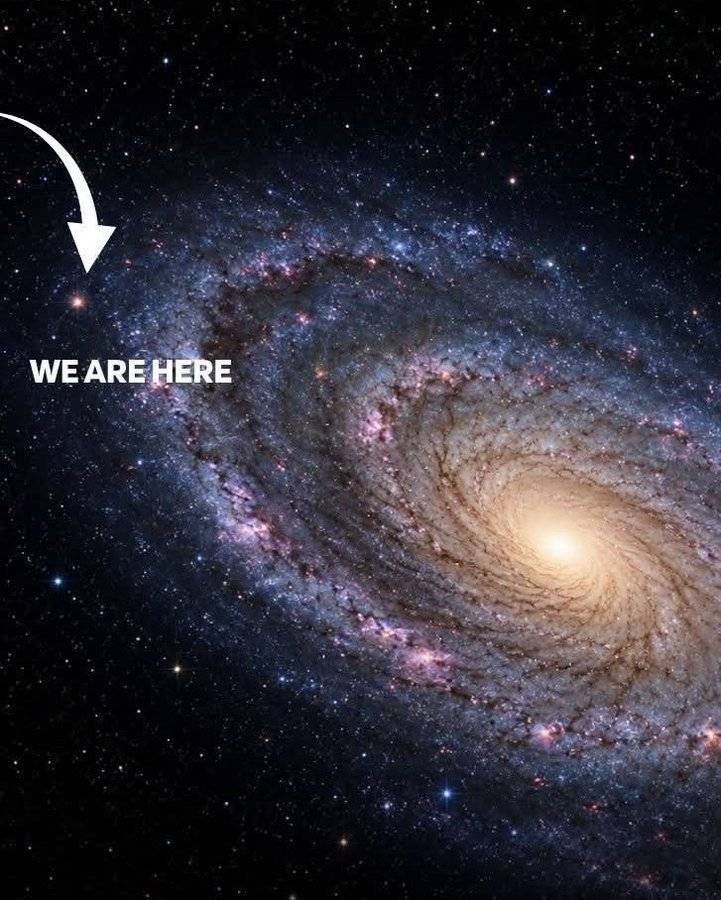
Scientists have pushed the boundaries of our cosmic home farther than ever before, uncovering what may be the most distant stars yet detected in the Milky Way—and revealing that our galaxy stretches dramatically beyond anything astronomers once imagined.For generations, pinning down the Milky Way’s true “edge” has been like trying to measure where the ocean ends while standing in thickening fog. Galaxies don’t simply stop; their stars thin out gradually, fading into the darkness. Now, cutting-edge observations have spotted individual stars hundreds of thousands of light-years from the galactic center—regions so remote they were long hidden from view. These stellar pioneers are forcing scientists to redraw the map of our galaxy on an epic scale.Imagine our home galaxy as a colossal, spinning city of stars: hundreds of billions of suns, vast glowing nebulae, rivers of gas and dust, and invisible oceans of dark matter, all orbiting a shared center. Our Solar System orbits quietly in a suburban lane about 26,000 light-years from downtown. Yet these newly discovered outposts lie many times farther out—deep in the galactic halo, where the lights grow sparse and ancient history lingers.By carefully tracking the motions, chemistry, and distances of these far-flung stars, astronomers are reading the Milky Way’s autobiography. These outer sentinels carry clues about how our galaxy assembled itself over more than 13 billion years, swallowing smaller galaxies and weaving their stars into its own vast structure.One of the most thrilling lessons from modern astronomy is this: what we see in dazzling telescope photos is only the bright core of something far grander. Invisible halos of stars and dark matter balloon outward, often doubling or tripling a galaxy’s known size. The Milky Way, it turns out, is no exception—it’s a giant that’s been quietly hiding its true scale in the cosmic shadows.These discoveries don’t just expand our galactic map; they remind us how much more of the universe remains to be explored, right in our own cosmic backyard. The Milky Way is bigger, older, and more mysterious than we thought—and the story is still being written among the stars.
0 likes · 0 comments · 0 shares