Post by Udeze Nestor (@Nesmoore1)
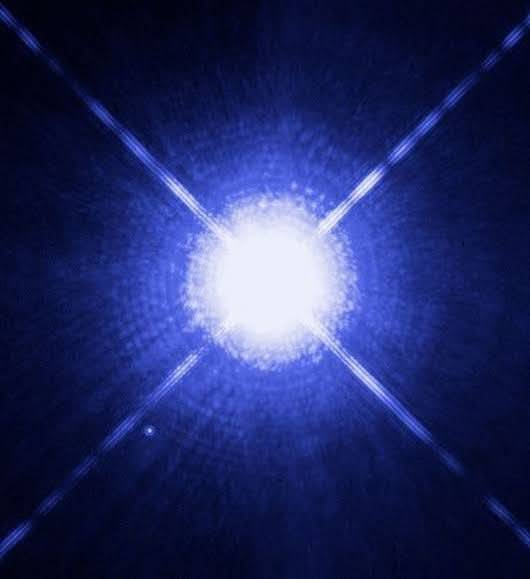
Sirius: The Blazing “Dog Star” That Rules Our Night Sky — And It’s Hiding an Incredible Secret! Sirius isn’t just the brightest star you can see from Earth — it’s a cosmic powerhouse located a mere 8.6 light-years away in the constellation Canis Major. It’s also the closest star to us that’s significantly more massive than the Sun. This dazzling system is actually two stars locked in an eternal gravitational dance.Sirius A — The Brilliant Blue-White GiantThe star we all see is Sirius A. It’s a beast compared to our Sun:2.06 times more massive
Roughly 1.7 times wider (diameter of about 2.4 million km)
Surface temperature of nearly 9,850 Kelvin, giving it that unmistakable brilliant bluish-white glow that outshines everything else in the night sky
Sirius B — The Tiny White Dwarf CompanionOrbiting Sirius A is its mysterious companion, Sirius B — one of the most extreme objects in our cosmic neighborhood.
Once a star heavier than the Sun, it burned through its fuel and collapsed into a white dwarf. Now it’s:Only 12,000 km across — about the size of Earth
Yet it still packs nearly the mass of the Sun
Insanely hot at 25,000 Kelvin
The two stars complete one orbit around each other every 50 years.What Happens Next?Sirius A is too light to explode as a supernova (you need at least 8 solar masses for that kind of fireworks). Instead, in the distant future it will swell into a red giant, puff off its outer layers in a beautiful planetary nebula, and finally shrink into a second white dwarf. The system will eventually become a pair of quiet, cooling stellar remnants slowly circling each other for billions of years.Sirius is living proof that even the brightest stars in our sky have rich, dramatic life stories — from fiery youth to quiet old age.
0 likes · 0 comments · 0 shares