Post by Làgídìgbò (@aHeritager)
THE STORY BEHIND TINUBU'S CAP: SYMBOLISM, POLITICS AND THE FACTS
#aHeritager
One of the most recognizable features of President Bola Ahmed Tinubu's public appearance is his traditional Yoruba cap, popularly known as a fila. Over the years, a distinctive symbol embroidered on the cap has attracted public curiosity, political debate, and, more recently, social media speculation.
The symbol, which resembles a broken chain or broken shackle, became the subject of widespread discussion during the build-up to Nigeria's presidential election. Various interpretations emerged online, with some social media users alleging that the design was linked to the ancient Ouroboros symbol. The claim quickly gained attention, particularly within the heated atmosphere of political competition.
However, available evidence and Tinubu's own explanations tell a different story.
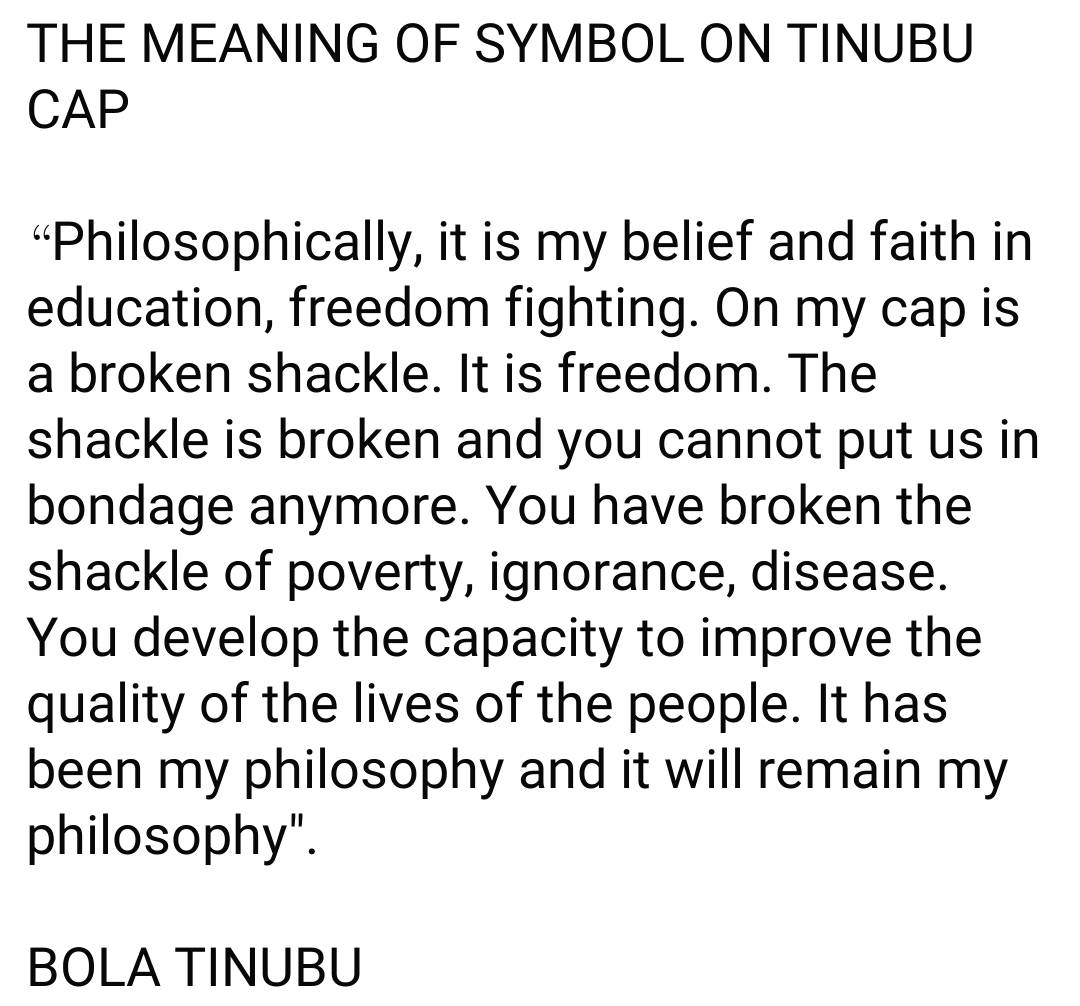
According to Tinubu, the emblem on his cap represents a broken shackle, symbolizing freedom, liberation, and the breaking of barriers that keep people trapped in poverty and underdevelopment. Philosophically, he has linked the symbol to his belief in education, personal advancement, and the struggle for freedom. In this interpretation, the broken chain is not a sign of bondage but rather a representation of emancipation and opportunity.
The symbol gained further prominence when it featured prominently during celebrations marking his birthday and the launch of the book 'The Last Man Standing'. Images focusing on the back of his cap drew public attention to the design and sparked renewed interest in its meaning.
The controversy surrounding the logo was fueled by comparisons with the Ouroboros, an ancient symbol traditionally depicted as a serpent or dragon consuming its own tail. Throughout history, the Ouroboros has appeared in various civilizations, including Ancient Egypt and Greece, where it represented concepts such as eternity, renewal, continuity, and the cycle of life, death, and rebirth.
Despite online claims, no credible evidence has emerged linking Tinubu's cap symbol to the Ouroboros or to any cultic organization. Independent reviews of the design suggest that the emblem more closely resembles a broken chain than the circular serpent associated with the ancient symbol. Likewise, there have been no verified reports connecting Tinubu to the Ouroboros tradition or any similar organization.
The episode serves as a reminder of how quickly speculation can spread in the digital age. Political symbols often attract scrutiny, and images shared online can sometimes generate interpretations far removed from their original intent. In an era dominated by social media, distinguishing between fact, opinion, and rumor has become increasingly important.
Whether viewed as a political statement, a personal philosophy, or a symbolic representation of overcoming hardship, the broken-shackle emblem has become one of the most recognizable visual trademarks associated with Tinubu's public image. What remains clear is that the symbol's publicly stated meaning is one of liberation from poverty and limitation rather than any connection to the ancient Ouroboros symbol.
As with many political narratives, the facts are often less dramatic than the rumors—but they are ultimately more important.
Political Insight: Symbols matter in politics because they communicate ideas without words. Their true meaning, however, is best understood through evidence rather than speculation.
#ClimateAction #SafeCommunities #Nigeria #ProtectOurFuture #Trending #BringBackOurChildren #aHeritager
0 likes · 0 comments · 0 shares