Post by Udeze Nestor (@Nesmoore1)
There is a strange and beautiful irony at the heart of general relativity: Einstein wrote the equations, but he was not the first person to solve them exactly.
That may sound surprising if we imagine physics as a straight line from theory to answer, but equations in fundamental physics do not behave like simple puzzles waiting for a neat solution. Writing down the correct equations is already a monumental achievement. Solving them is another problem entirely. The Einstein field equations are not just difficult; they are nonlinear equations describing how matter, energy, space and time influence one another. In simple terms, they say that mass and energy tell spacetime how to curve, and curved spacetime tells matter how to move. But turning that statement into an exact description of a real gravitational field is brutally hard.
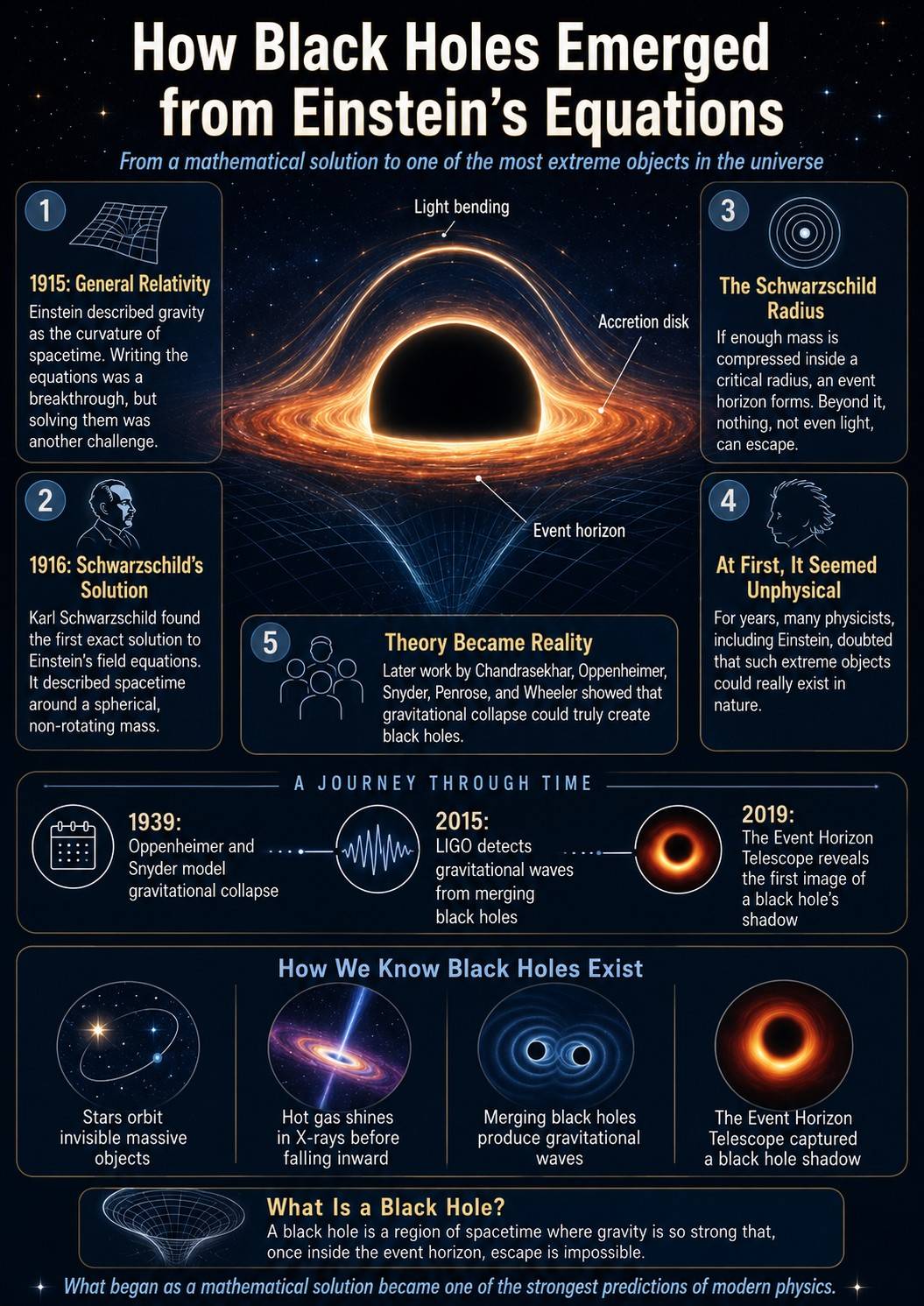
Einstein knew this. When he completed general relativity in 1915, he had built a new theory of gravity in which gravity was no longer a force acting across space, as in Newton’s picture, but the geometry of spacetime itself. Massive objects do not simply pull on other objects. They reshape the structure through which everything moves. Planets orbit the Sun not because they are dragged by an invisible rope, but because they follow the natural paths available in curved spacetime.
The theory immediately explained one of the great anomalies of astronomy: the small extra shift in Mercury’s orbit around the Sun, which Newtonian gravity could not fully account for. Einstein had used an approximate solution for that problem. But the full equations were so complex that even he did not expect simple exact solutions to appear quickly.
Then came Karl Schwarzschild.
Schwarzschild was not an obscure amateur. He was a brilliant German physicist and astronomer, director of the Potsdam Observatory, with deep expertise in celestial mechanics, photometry and mathematical physics. When the First World War broke out, he volunteered for military service despite being over forty. While serving on the front, in the middle of war, he found time to do something extraordinary: he derived the first exact solution to Einstein’s field equations.
His solution described the gravitational field outside a perfectly spherical, non-rotating mass. That may sound like a simplified case, and it was, but in physics a clean idealization can reveal something profound. Schwarzschild showed what spacetime would look like around such an object. In the mathematics, a particular radius appeared naturally. Today we call it the Schwarzschild radius.
For an object with the mass of the Sun, that radius is about three kilometres. For Earth, it is less than one centimetre. This does not mean the Sun or Earth are black holes. It means that if all their mass were compressed inside those radii, the curvature of spacetime would become so extreme that an event horizon would form. Beyond that boundary, escape would no longer be possible. Not for matter. Not for radiation. Not even for light.
This was not how Schwarzschild’s result was understood at first. The mathematics contained what looked like a singularity at the Schwarzschild radius, a place where the equations seemed to behave pathologically. For decades, many physicists treated it as a mathematical oddity, a coordinate problem, or a sign that such a situation could never occur in nature. Einstein himself was deeply skeptical that real stars could collapse into such objects. The idea seemed too extreme, too pathological, almost like a warning that the theory had been pushed beyond its physical domain.
And in one sense, the early skepticism was understandable. A black hole is not an intuitive object. It is not simply a very dense star. It is a region of spacetime separated from the outside universe by a causal boundary. The event horizon is not a surface made of material. If you crossed it, locally nothing magical would have to happen at that exact point, especially for a very massive black hole. But globally, your future would change completely. Every possible path forward would lead inward. Escape would no longer be a question of engine power, speed or technology. It would be forbidden by the causal structure of spacetime.
The modern idea of the black hole took decades to mature. In the 1930s, Subrahmanyan Chandrasekhar showed that white dwarfs have a maximum mass. If a stellar remnant is too massive, electron degeneracy pressure cannot support it indefinitely. Later, neutron stars were understood as another possible endpoint of stellar evolution, supported by neutron degeneracy pressure. But even neutron stars have limits. Above a certain mass, no known pressure can halt collapse.
In 1939, J. Robert Oppenheimer and Hartland Snyder described the gravitational collapse of a massive star in general relativity. Their work showed that collapse could continue until an event horizon formed, at least in an idealized model. But the idea still remained marginal for a long time.
0 likes · 0 comments · 0 shares