Post by Deborah Udy Okusaga Akanne (@deborah_udy_okusaga)
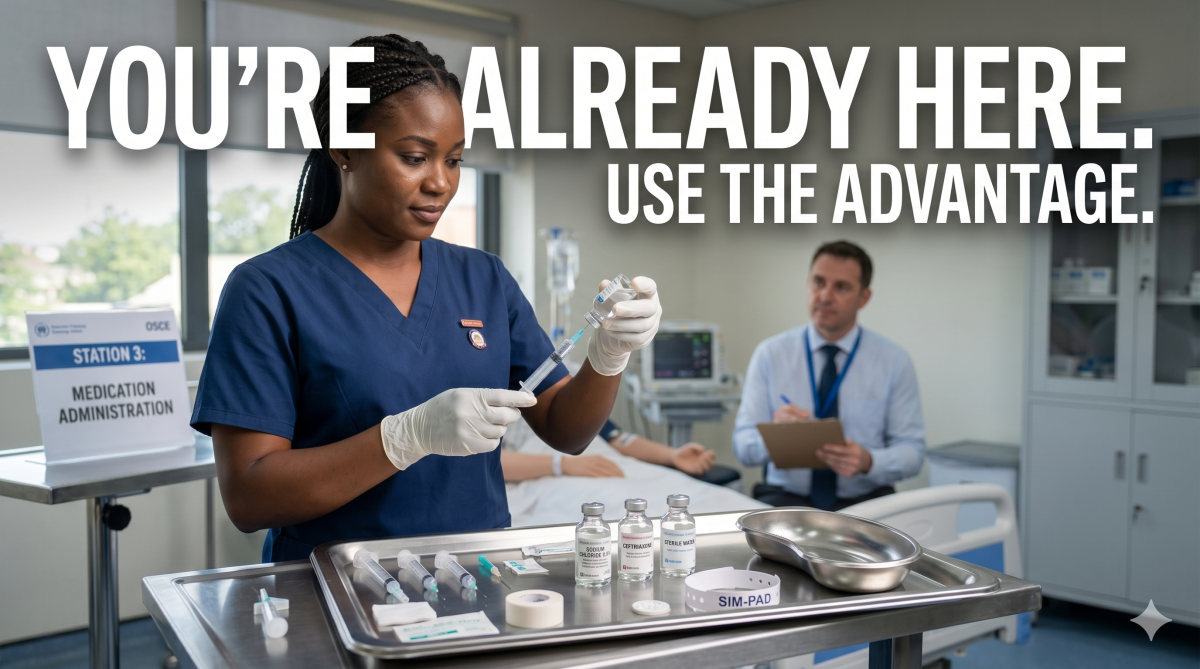
The OSCE is the last clinical gate between you and your NMC PIN — and the fact that you are already in the UK means you have an advantage over every overseas candidate that most nurses in your position are not using.
The OSCE is taken at NMC-approved test centres in the UK.
That means no flight bookings, no international travel costs, no accommodation in a foreign city the week before your exam.
You wake up in your own home. You travel to a UK test centre. You sit the exam.
That logistical simplicity is worth more than most people realise — not because it saves money, but because it removes the anxiety of unfamiliar environments from an already high-pressure examination.
The nurses who perform best in the OSCE are not the most experienced clinicians.
They are the most prepared ones — and preparation is easier when you are not simultaneously managing international travel.
What the OSCE tests:
— Verbalisation of clinical actions — if you did not say it, the examiner cannot mark it as done.
— ANTT — Aseptic Non-Touch Technique — the most common silent fail station.
— ABCDE assessment with NEWS2 calculation and SBAR escalation.
— Medicines administration using the five rights framework.
— Documentation completion within the station time.
None of these are beyond any qualified nurse. All of them require specific preparation for the OSCE format — because the OSCE is a performance assessment, not a clinical shift.
Being in the UK does not automatically prepare you for it. But it does give you the time and proximity to prepare properly.
💬 In need of a Verbalization Script and Silent Fail Checklist?
Comment OSCE and I will send it to you.
#NMCOSCE #OSCEPrep #InternationalNurses #CareHomeToNHS #NMCRegistration #UKNursing2026 #OSCETips #NMC2026 #InCountrySwitch #SovereignHealthcare
0 likes · 0 comments · 0 shares